
Her chin implant moved. The next plan moved bone.
The patient says an implant placed in 2021 became displaced and sat back toward her neck. In 2023, it was removed and her chin bone was advanced 9 millimeters. Her update at roughly 90 days shows why “permanent chin augmentation” is not one operation.
AI-assisted editorial analysis based on the linked patient discussion and named sources.Educational only—not medical advice. How we write

The search moment
If an implant can add projection, why would someone choose bone surgery instead?
First method
Implant
Revision method
Move bone
Early result
90 days
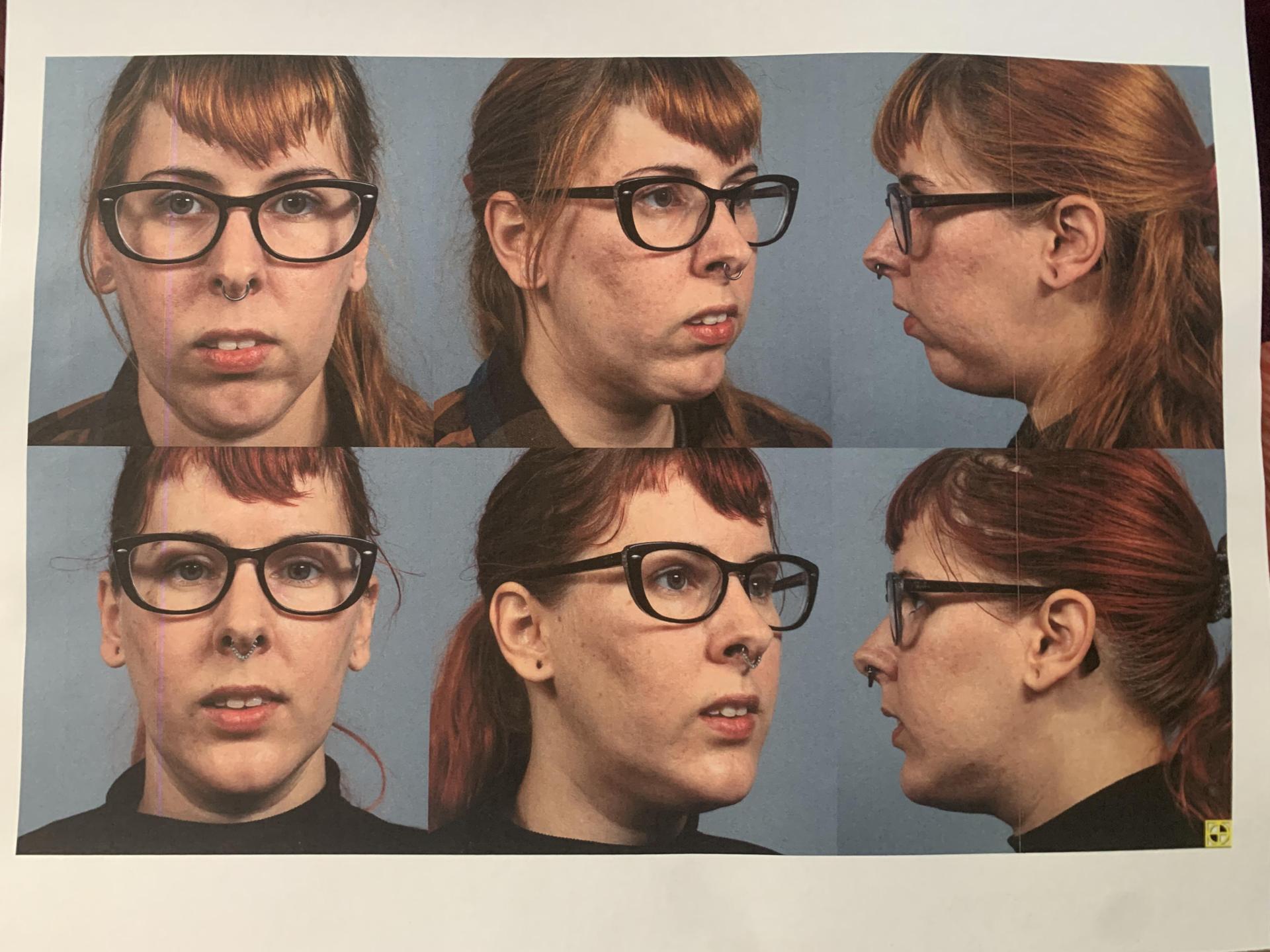
Photos from the original post
Labels follow the poster's own description.
Compare real results
Compare all six facial views
A useful chin case includes the bite, front view, smile, obliques, profiles, and the exact movement or implant.
See chin results2021
Implant placed
9 mm
Bone movement
90 d
Follow-up
The movement, displacement, cost, recovery, and satisfaction are self-reported. The clinical comparison uses Cleveland Clinic and ASPS patient guidance.
Here is what the original post actually said.
Why the implant came out
"It became displaced and gave me no forward projection."
The revision
"Removal and genioplasty performed in April 2023."
The movement
"We moved my chin forward 9mm."
An implant adds material. A genioplasty relocates bone.
A chin implant sits on the bone to change external contour. A sliding genioplasty cuts the chin segment and moves it forward, backward, upward, downward, or in a planned combination before fixing it with plates and screws. Those mechanics create different capabilities and risks.
In this story, the patient wanted more forward projection after an implant reportedly shifted backward. A 9 mm advancement was not simply a larger version of the same object; it changed the position of her own bony chin.
The front view is part of the decision.
Projection is often discussed from the profile, but chin width, vertical height, asymmetry, lip support, labiomental fold, and lower-face balance can change in front and three-quarter views. The poster said the result made her understand how much support had been missing across the face.
Ask for a plan in millimeters and directions, then review a front-view simulation cautiously. An implant shape can widen or square the chin; a bone movement can change projection and height without adding the same wraparound material.
Do not plan from one silhouette
Review the resting front, smiling front, both obliques, both profiles, bite, and soft-tissue movement.
The bite decides whether the chin is the whole problem.
Neither a chin implant nor an isolated genioplasty corrects every jaw relationship. A recessed chin can exist with a normal bite, but it can also sit beside an overbite, mandibular deficiency, airway concern, or asymmetry that calls for orthodontic or maxillofacial assessment.
Before cosmetic camouflage, ask whether the bite and jaw position are stable. A surgeon should explain why isolated chin treatment is sufficient or why orthognathic evaluation belongs in the workup.
Numb teeth at 90 days are not a footnote.
The patient reported that chin sensation returned quickly while her lower teeth remained numb in areas and intraoral healing felt strange. Sliding genioplasty places nerves and tooth roots near the operative field; altered sensation and dental injury are part of consent.
An implant has its own issues, including displacement, infection, contour visibility, and bone changes. “Less invasive” and “more natural” are not enough. Compare the specific complication, recovery, and revision paths for each operation.
Questions before choosing material or bone
The answer should cover bite, vectors, front-view change, fixation, and revision.
Is my bite and jaw position normal?
What horizontal and vertical movement do you recommend?
How will the front view and smile change?
If you recommend an implant, how is it sized and fixed?
If you recommend genioplasty, where are the tooth roots and mental nerve?
What does removal or revision involve for your plan?
Reddit: implant removal and 9 mm genioplasty
The patient’s displacement account, operative choice, movement, recovery, cost, and 90-day photographs.
Cleveland Clinic: sliding genioplasty
A clinical overview of bone movement, candidacy, recovery, and complications.
ASPS: chin surgery procedure
Patient guidance on implant placement, bone movement, incisions, and planning.
The questions that usually come next
Can a sliding genioplasty replace a chin implant?
Sometimes, but the procedures do different things. The right choice depends on projection, vertical height, width, asymmetry, bite, and risk tolerance.
Can a chin implant move?
Displacement is a recognized complication. Pocket design, fixation, anatomy, trauma, and healing can affect position.
Does genioplasty fix an overbite?
An isolated genioplasty moves the chin segment, not the entire lower jaw or bite. Orthodontic or jaw-surgery assessment may be needed.
Are 90-day genioplasty photos final?
No. Swelling and sensation can continue to change for months. They are an early milestone.
Compare all six facial views
A useful chin case includes the bite, front view, smile, obliques, profiles, and the exact movement or implant.
See chin results