
The old tummy tuck had to be redone.
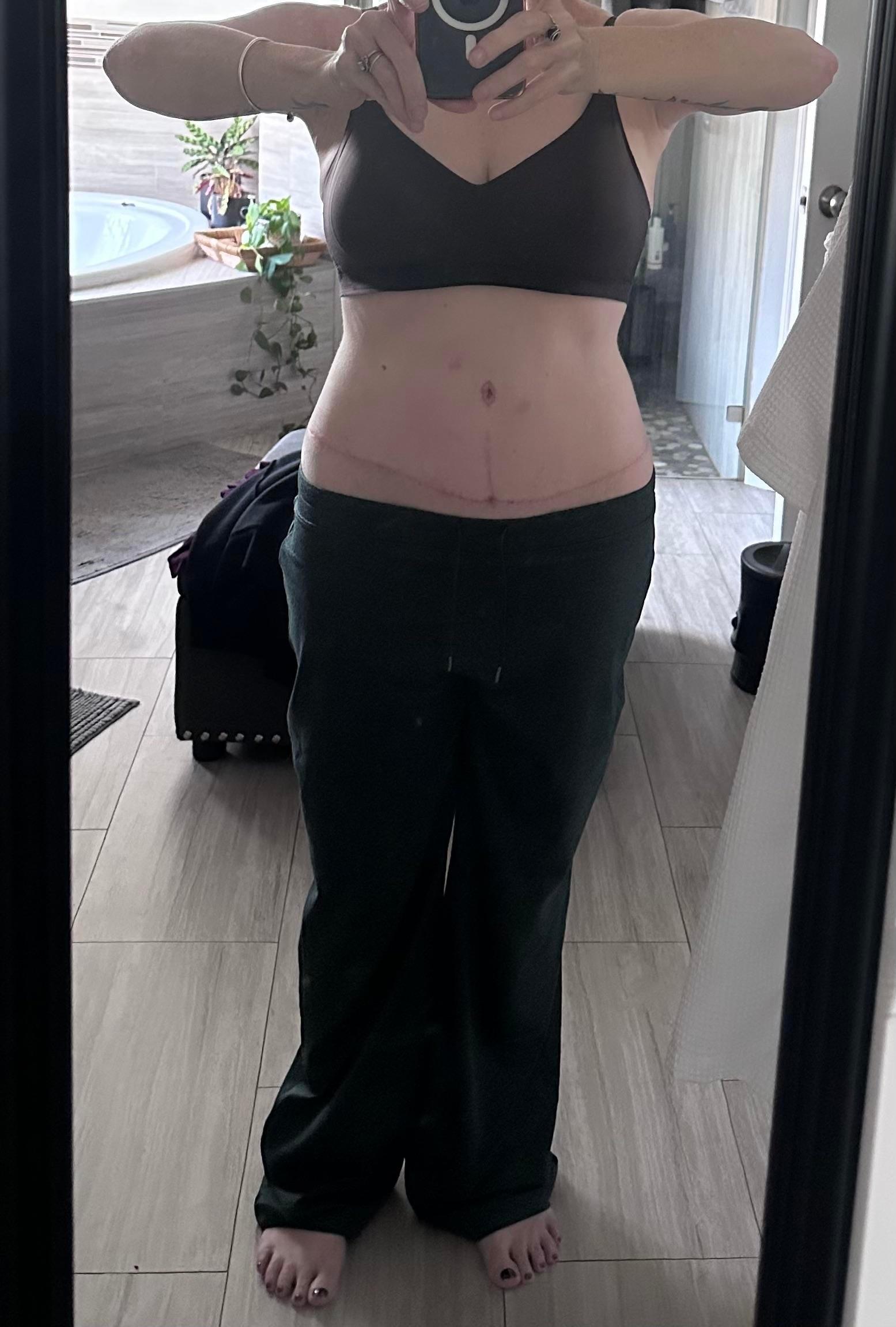
At seven weeks after a lower body lift, the poster explained why she chose the longer scar: more than 120 pounds of weight loss had left loose tissue around the buttocks and outer thighs, while a prior tummy tuck had treated only part of the problem.
AI-assisted editorial analysis based on the linked patient discussion and named sources.Educational only—not medical advice. How we write

The search moment
Do I need a longer scar because the loose skin continues past the front of my abdomen?
Problem area
Circumferential
Scar
Around the body
Stage
Early recovery
Photos from the original post
Labels follow the poster's own description.

Compare real results
The back view is not optional
Compare matched front, side, oblique, and back photographs from patients with similar weight loss and tissue distribution.
See body-contouring results120+ lb
Weight lost
7 wk
Follow-up
Tummy tuck
Prior surgery
The source gallery shows early postoperative progress. Seven weeks is too early to treat scar, swelling, or contour as final.
Here is what the original post actually said.
Why 360 degrees
"My butt and outer thigh area was pretty significant as I carried all my weight in that area."
The prior plan
"I actually had a tummy tuck years ago and it wasn’t great."
Her conclusion
"I should’ve had a 360 incision and lift all along."
The back view explains the operation.
A tummy tuck primarily addresses the abdomen. An extended tummy tuck carries the excision farther toward the flanks. A lower body lift continues circumferentially so the surgeon can address the abdomen, waist, outer thighs, and buttock region in one connected plan.
The poster’s reason was not simply “more skin.” It was where the laxity lived. Her front-only operation did not address the posterior and lateral tissue that mattered after major weight loss.
A longer scar buys access, not a guaranteed better result.
The circumferential incision lets the surgeon remove and lift tissue around the torso. It also lengthens the wound, changes positioning, and can make sitting, sleeping, mobility, and wound care harder. The trade only makes sense when the added zones matter enough to the patient.
Ask the surgeon to draw the expected scar while you are standing and show where it may rise at the hips or back. Then ask which outer-thigh and buttock changes are realistic. The label lower body lift does not guarantee every posterior contour will be corrected.
Make the scar earn its length
For every extra section of incision, ask what anatomy it reaches and what visible change it is intended to create.
Seven weeks is progress, not a final photograph.
The poster reported improving mobility, settling incisions, and decreasing swelling. Those are useful recovery details. They also warn against judging symmetry, scar color, or the final outer-thigh contour this early.
Ask the practice for milestones at two weeks, six weeks, three months, six months, and one year. A realistic timeline includes swelling that shifts, tightness, numbness, fatigue, garment use, wound checks, and restrictions that differ from a routine desk-work estimate.
A second operation should explain why the first plan was too small.
When a tummy tuck is being redone, the consultation should separate recurrent change from an original scope mismatch. Weight fluctuation, tissue quality, healing, scar placement, and untreated posterior laxity can all contribute.
Bring the first operative report and preoperative images. Ask what will be excised again, whether the old scar can be incorporated, and how the new plan manages blood supply across previously operated tissue.
Questions before choosing the 360-degree scar
The answers should identify zones, scars, staging, and recovery logistics.
Where does my loose tissue continue beyond the abdomen?
What would an extended tummy tuck leave behind?
What will the body lift change in the buttocks and outer thighs?
How will the prior tummy-tuck scar be handled?
Where can wound tension be highest?
How much help will I need for sitting, sleeping, and dressing?
Reddit: seven-week lower-body-lift update
The patient’s weight-loss history, prior tummy tuck, reason for choosing a 360-degree operation, and source images.
ASPS: the basics of belt lipectomy
A patient-facing overview of circumferential body lifting after major weight loss.
ASPS: choosing a tummy-tuck type
Differences among mini, full, extended, and fleur-de-lis patterns.
The questions that usually come next
Is a lower body lift the same as a 360 tummy tuck?
Terms vary. Confirm exactly which abdomen, flank, buttock, and outer-thigh tissues the surgeon plans to lift and where the scar will run.
Why might a tummy tuck be redone during a lower body lift?
A prior front-only plan may not match circumferential laxity, or the abdomen may need revision. The old report and examination should explain why.
Are seven-week photos final?
No. Swelling, scar color, tightness, and contour continue to change for months.
Does a lower body lift lift the butt?
It can raise posterior tissue, but the degree and shape change depend on anatomy and technique. Ask for similar back-view cases.
The back view is not optional
Compare matched front, side, oblique, and back photographs from patients with similar weight loss and tissue distribution.
See body-contouring results