
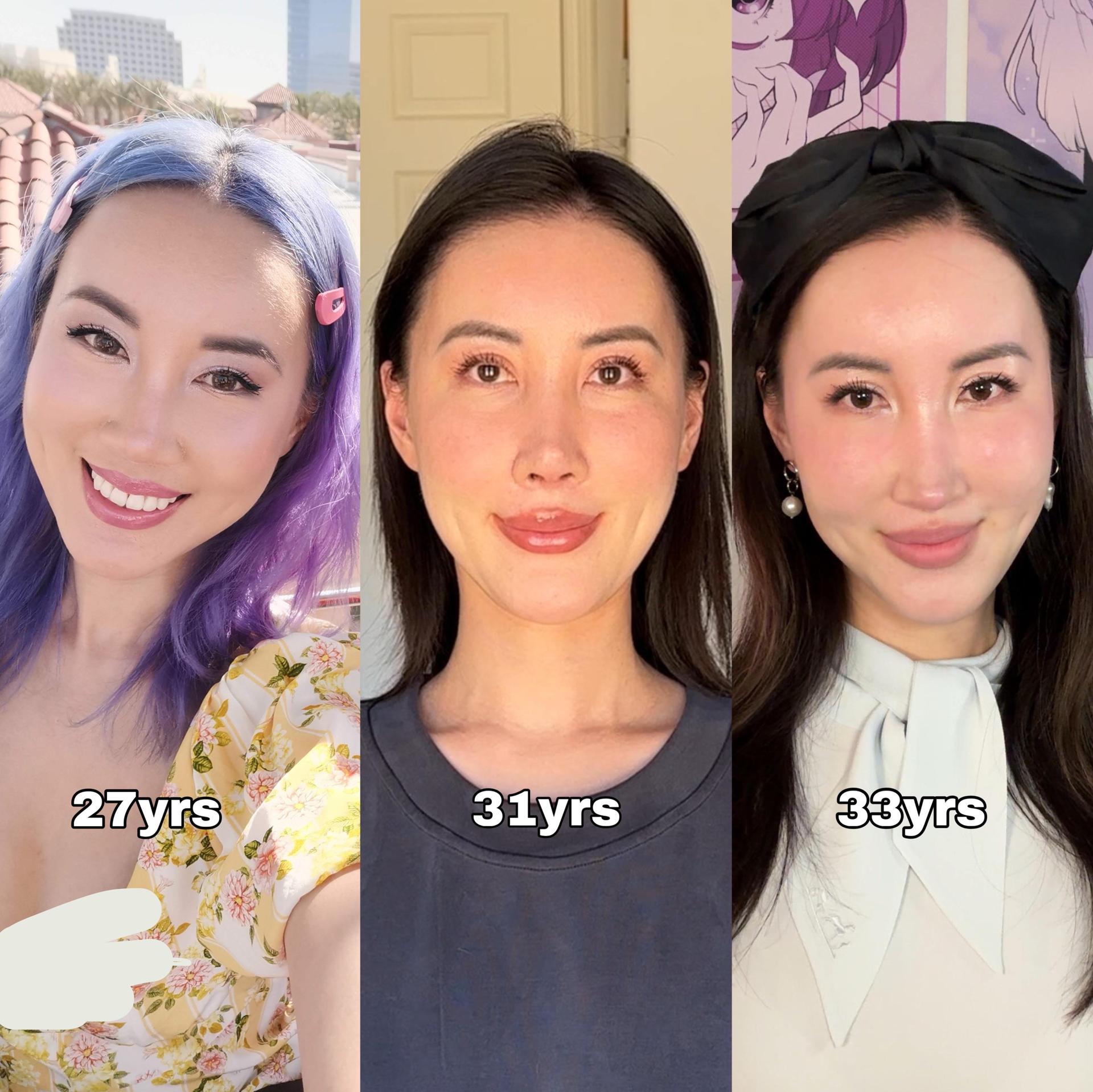
One month after her fourth fat transfer.
The patient compared her face before age 30, after aging and a 30-pound loss, and one month after a fourth fat-transfer session. The newest treatment included the forehead, temples, lower cheeks, one under-eye, and a small mid-cheek touch-up.
AI-assisted editorial analysis based on the linked patient discussion and named sources.Educational only—not medical advice. How we write

The search moment
If the result took four rounds, what should a first-session patient expect?
Areas
Forehead to cheek
Swelling
Still evolving
Treatment model
Staged
Photos from the original post
Labels follow the poster's own description.
Compare real results
Look for long follow-up and exact areas
Compare patients with similar volume loss, session counts, donor sites, and standardized photos.
See fat-transfer results4
Sessions
1 mo
Latest photo
30 lb
Weight loss
The poster also disclosed multiple rhinoplasties. The photographs are useful for her timeline but cannot isolate every facial change to fat transfer.
Here is what the original post actually said.
The latest session
"I just got my 4th round of facial fat transfer 5wks ago."
What changed before treatment
"Natural aging and weight loss of 30lbs."
Her recovery report
"Swelling significantly reduces after 1wk and takes 4 months to fully look normal."
Four rounds are not one oversized result.
Facial fat grafting is often conservative because transferred fat survival varies and overcorrection can be difficult to manage. Staging can let a surgeon evaluate retained volume before adding more. It also means the endpoint, cost, and donor-site burden cannot be understood from a first-session quote alone.
Ask whether the surgeon expects one session or is describing the first step of a series. Request the injected volume by area, the donor sites, and the practice’s own re-treatment rate.
The one-month photograph contains swelling.
The poster said her swelling drops substantially after the first week but takes about four months to feel normal. Her newest image at roughly one month therefore shows recovery and result together.
A fair photo review needs the same light, lens, facial expression, head position, makeup, and distance. Even then, the comparison documents the whole timeline, not the survival percentage of each graft.
Ask for the boring photograph
The most useful image is standardized, unfiltered, and taken after swelling has settled. It is rarely the most flattering reveal.
Every added area changes the risk map.
The latest session included the forehead, temples, cheeks, and under-eye region. Fat placed around the eye or forehead requires detailed anatomical knowledge. Rare vascular complications can be severe, and permanence makes restraint important.
Ask who performs the harvesting and injections, how the fat is processed, which planes are used, and what emergency protocol exists. “Natural” describes the source material; it does not mean the procedure is casual.
The comparison cannot isolate fat transfer from the rest of her history.
The poster disclosed that the images also span several rhinoplasties. Weight loss, aging, hairstyle, makeup, camera choices, and nasal surgery can all change how facial balance reads.
That does not make the story useless. It makes it honest. The useful takeaway is the staged process and recovery timeline, not a claim that one syringe or one session recreated an earlier face.
Questions before the first session
A strong plan names areas, volumes, donor sites, stages, and stopping rules.
How many sessions do you expect for my goal?
What volume will you place in each area?
Which donor sites are available?
When do you judge retained volume?
Which areas carry the highest vascular risk?
What would make you advise against adding more?
Reddit: four-round facial fat-transfer update
The patient’s treatment areas, number of sessions, weight-loss context, recovery description, and source comparison.
ASPS: facial fat grafting vs fillers
A patient comparison of donor fat, injectables, downtime, longevity, and planning.
ASPS: fat-injection procedure and risks
Patient guidance on harvesting, processing, injection, recovery, and complications.
The questions that usually come next
Why might facial fat transfer need several sessions?
Retained volume varies, goals may be conservative, and the surgeon may stage areas or wait to judge survival before adding more.
Is one month a final fat-transfer result?
Usually not. Swelling and tissue settling continue, and the treating practice should provide its own timeline.
Is facial fat transfer safer because the material is natural?
Using the patient’s own fat avoids some filler-specific issues, but harvesting and facial injection still carry surgical and vascular risks.
Can these photos prove fat survival?
No. They are not a controlled measurement, and the timeline includes weight change, aging, other procedures, and early swelling.
Look for long follow-up and exact areas
Compare patients with similar volume loss, session counts, donor sites, and standardized photos.
See fat-transfer results