
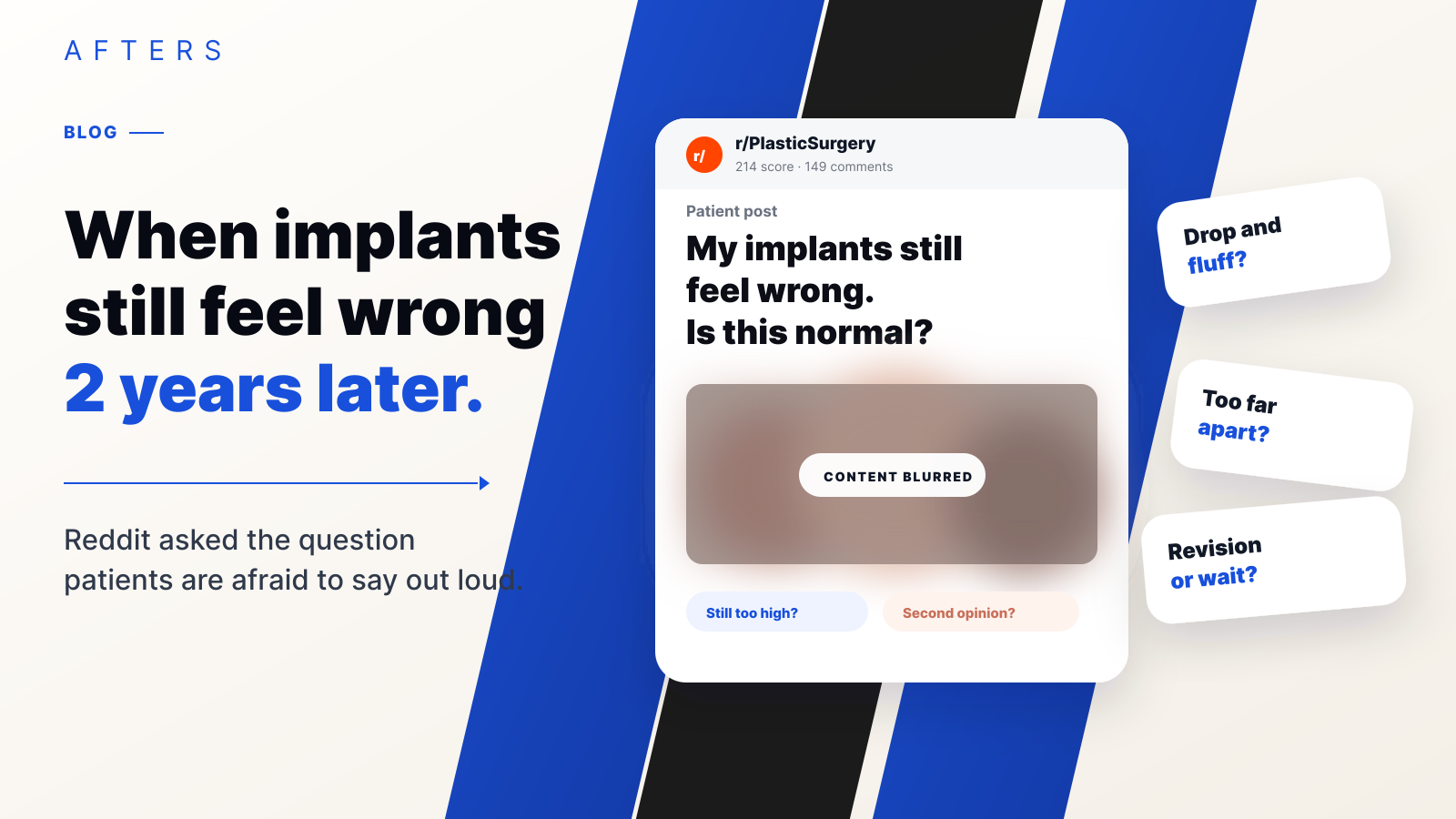
When your breast implants still feel wrong two years later, here’s the real question to ask
The scary part isn’t only that your result looks different than you hoped. It’s not knowing whether you’re supposed to wait, worry, or ask someone to look.
Second opinion prep
Two years later, the question changes.
This isn’t about strangers judging a photo. It’s about walking into an exam with enough language to understand what can and can’t be changed.
Timeline
What’s still normal settling, and what’s likely final?
Anatomy
How much of the look comes from your chest width, tissue, and implant size?
Revision
If something can be changed, what’s the tradeoff?
Explore on Afters
Use the article to name what you’re seeing. Then compare real breast augmentation results by timeline, anatomy, and implant style.
Breast augmentation
Find results that match the question you’re actually asking
Also helpful
This isn’t a “be patient” question anymore
Early healing asks for patience. Two years asks for clarity. If your implants still feel too high, too wide, too hard, or just wrong after all this time, the helpful sentence isn’t "maybe they’ll settle." It’s "here’s what a surgeon would actually need to look at."
The woman who posted said her implants still sat high and far apart two years after surgery. She’d been told they’d drop and settle, and they just hadn’t, not the way she expected. That’s the exact moment you end up online at night, because you don’t yet know if you’re even allowed to be worried. You are.
What the comments were really doing
The replies weren’t just rating a photo. They were helping her name the next step: stop measuring herself against old promises and go get a fresh, qualified opinion.
What drop and fluff can explain
Right after breast augmentation, implants can look high, tight, square, or bigger than you expected. "Drop and fluff" is just the name for them settling lower and softening over the first months, as swelling goes down and your tissue relaxes around them.
ASPS notes that whole settling process can take three to six months. That timeline matters here, because her post wasn’t a week-three panic. It was a two-year question, and that’s a different thing.
Clinical context
ASPS explains that drop and fluff can take three to six months and depends on individual healing.
ASPS notes implant displacement and shape changes as signs that may lead patients to ask about revision.
ASPS describes capsular contracture as scar tissue tightening around an implant and becoming unusually hard.
FDA patient guidance says breast implants aren’t lifetime devices and lists the common local complications.
What two years changes
At two years, the question shifts. You’re no longer asking "could this just be early swelling?" You’re asking what a surgeon actually sees when they examine your result in person.
That doesn’t mean a Reddit thread can diagnose anything. But it does mean your worry deserves more than "just wait." A qualified second opinion can look at where the implant sits, your tissue and chest anatomy, the scar capsule, your symptoms, and the result you were hoping for in the first place.
Still high after 3-6 months
Worth a follow-up, especially if one side isn’t moving
Still high after 1-2 years
A second opinion is reasonable
Hardness, pain, or distortion
Ask about the scar capsule and where the implant sits
Too far apart for your goal
Ask about your anatomy, implant width, the pocket, and tradeoffs
The thread was really about what to do next
The original post had sensitive patient photos, so we’re not republishing them. The useful part for you is the pattern in the comments: people trying to tell apart normal settling, your anatomy, a possible complication, and when revision even enters the picture.
Posted in r/PlasticSurgery by u/[redacted] Jun 17, 2026
Patient post
149 commentsSensitive imagesShe asked why her breast implants still looked high and far apart two years later
The post said her implants hadn’t dropped the way she expected after two years, and asked whether it was her anatomy, healing, the implant choice, or something that needed another opinion.
We’re not republishing the Reddit photos. Open the original thread if you want to see the source post, and use this article for the questions it’s worth bringing to a consult.
Is this still normal healing?
Did my implants ever really drop?
Are they too high or too far apart?
Is this my anatomy or the surgical pocket?
Do I need a second opinion?
What would revision actually involve?
u/[redacted]
post upvotes · Jun 2026
"They are so far apart and will not drop and it has been two years."
This is the moment you start searching at night. She isn’t fishing for compliments. She’s trying to figure out whether waiting still makes any sense.
u/[redacted]
546 upvotes · 18h ago
"Is this a botch, or just your anatomy?"
That one question is really the whole article. Is it a result problem, your anatomy, the implant choice, the pocket, healing, or something else entirely?
u/[redacted]
84 upvotes · 18h ago
"I honestly do not know tbh."
This is why you scroll the comments. You’re hunting for the words before you can even form the next question to ask a surgeon.
u/[redacted]
272 upvotes · 17h ago
"The time for the drop and fluff already passed after the one year mark."
It’s not a diagnosis, but it puts a finger on the gap between normal early healing and a worry that’s stuck around for years.
u/[redacted]
149 upvotes · 18h ago
"It could be the implant profile and the placement."
The most useful comments weren’t only kind. They pointed at concrete things to ask about: the implant profile, where it sits, your anatomy, and whether revision is an option.
u/[redacted]
8 upvotes · 13h ago
"Cant tell much in these pics."
This is the honest guardrail. A thread can tell you your worry is valid, but only an exam can tell you what’s actually going on.
Why implants can look too high or too far apart
Photos alone can’t give you one clean answer. A result can look wide, high, hard, or too separated for a handful of reasons: your natural anatomy, the implant’s width and profile, whether it sits under or over the muscle, the pocket made during surgery, how much tissue covers it, the scar capsule, or simply a gap between the look you wanted and what your body can safely hold.
So the better consult question isn’t "who’s right in the comments?" It’s "what are the possible causes in my case, and which ones can actually be changed?"
What to ask for
Ask the surgeon to point at your own photos and walk you through what they think is your anatomy, what’s where the implant ended up sitting, and what a revision could realistically improve.
When revision becomes part of the conversation
ASPS describes breast implant revision as highly individual. Some revisions are a fairly simple implant swap. Others are bigger: changing the pocket, working on the scar capsule, adding tissue support, a lift, or fat transfer.
That’s why a good second opinion shouldn’t just tell you whether your result is "bad." It should tell you what revision would actually involve, what it could improve, what it might not fix, and what new scars, costs, risks, and tradeoffs come with it.
At two years post-op, what parts of my result are likely final?
Do my implants look high because of my anatomy, the implant profile, where the implant sits, the scar capsule, or something else?
Are my implants under the muscle or over it, and how could that affect the look?
Do you see signs of the scar tissue tightening, the implant shifting, or the implant sitting in the wrong spot?
Would revision mean changing implant size, profile, where the implant sits, under or over the muscle, or adding fat?
If I do nothing, what’s likely to change and what isn’t?
The capsule question
In the thread, one commenter raised the chance of capsule-related changes, meaning the scar tissue around the implant. No stranger can diagnose that from a photo, but it’s a real thing worth asking about.
Capsular contracture is when the scar tissue around the implant tightens and gets unusually hard. The FDA lists it, along with another surgery and implant removal, among the most common complications people run into with breast implants.
Please don’t diagnose this from comments
If you have firmness, pain, distortion, new asymmetry, swelling, or any change that worries you, the next step is an exam, not a comment thread.
How to compare results without spiraling
If you’re scrolling other people’s results while worried about your own, try not to compare cup size or cleavage alone. Look at starting anatomy, implant width and profile, under or over the muscle, spacing, softness, and timeline. A good comparison should sharpen your next question, not send you down a 2 a.m. rabbit hole.
Match your timeline to the photo’s timeline. Week 3, month 3, year 1, and year 2 are completely different questions.
Look for someone whose starting anatomy looks like yours, not just the cleavage you want.
When the surgeon shares it, notice whether the implant sat under or over the muscle.
Notice implant width and profile. A narrow, projecting implant can look very different from a wider, flatter one.
Look for front, side, and relaxed photos. One flattering angle can hide spacing or height.
Save the result you want and the result you’re worried about. Both are genuinely useful in a consult.
What to bring to a second opinion
If this thread sounds like you, bring more than screenshots. Bring your operative details if you have them, your implant size and profile, whether they’re under or over the muscle, dates, notes on any symptoms, and photos from early healing through now.
Bring goal photos too. Not dream-girl photos, but examples that show the spacing, slope, softness, and proportion you mean when you say "natural," "closer together," or "less high."
Comment sentiment
The comments were anxious, not vain
These percentages are an editorial read of the visible comment patterns, not a clinical study. The point is the pattern: the thread was about uncertainty and what a patient should ask next.
The bottom line
If your breast implants still feel wrong two years later, you’re not being dramatic for wanting answers. You may not know yet whether it’s your anatomy, healing, the implant choice, the pocket, the capsule, or a gap between what you pictured and what you got. But you’re completely allowed to ask.
Here’s the kind thing a thread like this can do: it makes you feel less alone and hands you the questions a real consult should answer. The next step isn’t to let strangers diagnose you. It’s to walk into a qualified second opinion with better words and a little less fear.
Questions this thread raises
How long does drop and fluff usually take after breast augmentation?
Drop and fluff is just your implants settling lower and softening over the first months. ASPS says it can take about three to six months, though every body heals on its own clock. If yours still look high, hard, or really out of position long after that, it’s completely reasonable to book a follow-up or get another qualified opinion.
Is it normal for breast implants to still be high after two years?
Two years is well past the usual early settling window. It doesn’t automatically mean something is wrong, but it does mean your question deserves a real in-person exam with a board-certified plastic surgeon who can actually look at implant position, your tissue, the pocket, the capsule, and any symptoms.
What can make breast implants look far apart?
A few things can affect spacing: your natural chest anatomy, the implant’s width and profile, where the implant sits, how much tissue covers it, and whether an implant has shifted. Photos alone can’t tell you which one it is.
When should I ask about breast implant revision?
It’s worth asking about revision if an implant keeps sitting in the wrong spot, or if you have hardening, pain, visible distortion, asymmetry that isn’t improving, or a result that’s still far from what you agreed on once healing is done. A second opinion can help you understand whether revision is even possible and what tradeoffs come with it.
Can Reddit tell me if my breast augmentation was botched?
No. Reddit can help you feel less alone and hand you better questions, but it can’t diagnose a surgical result. Use the thread for the words, then bring your photos, operative details, implant info, and symptoms to a qualified surgeon.