
Day 10 after rhinoplasty and panicking: what is too early to judge
There’s a very specific kind of fear that hits the moment the splint comes off. Your face looks different. The swelling is confusing. And you genuinely can’t tell if you’re healing or if you just made a terrible mistake. If that’s you tonight, take a breath. Let’s talk it through.
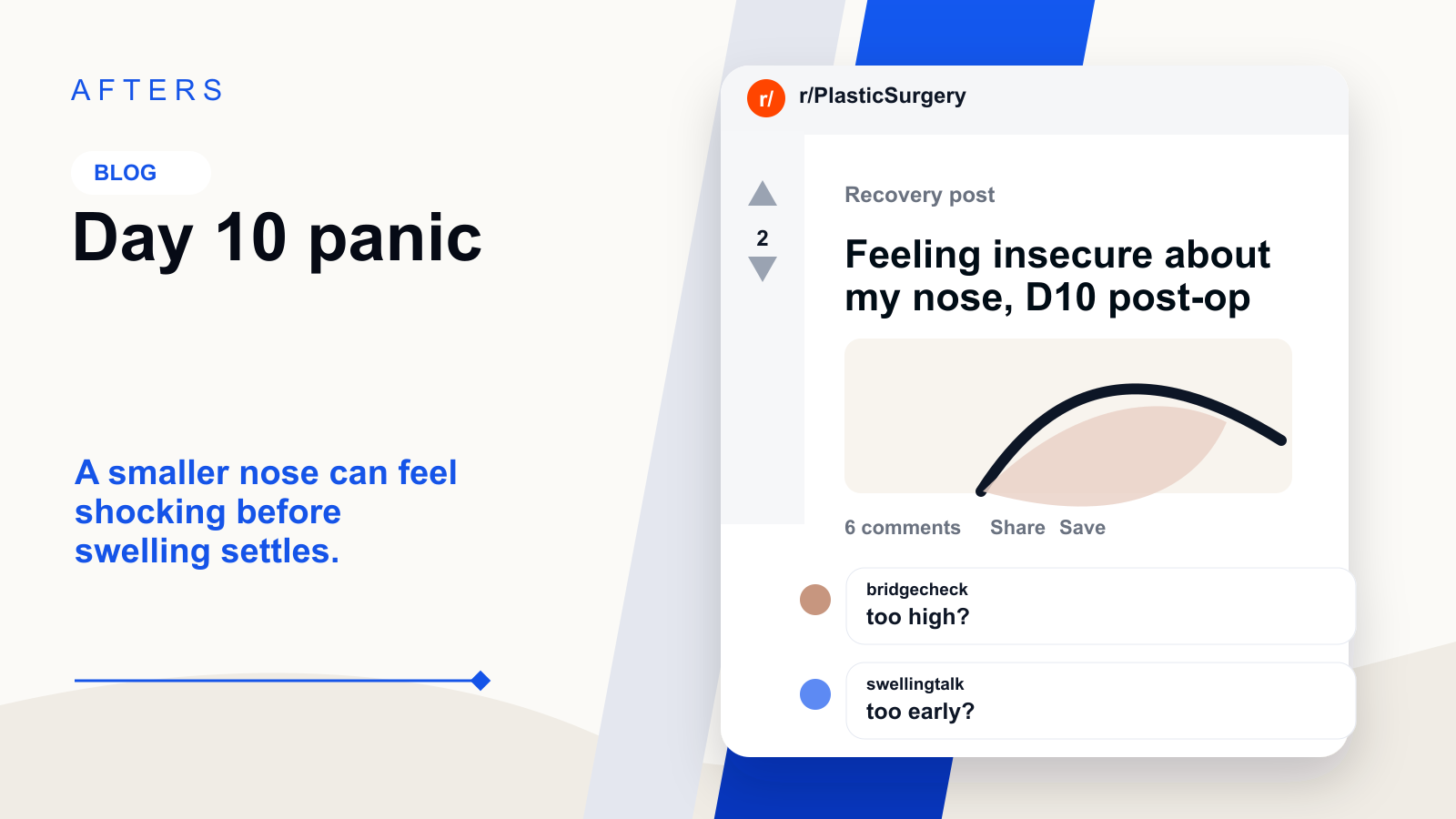
The search moment
My nose looks too high, too small, not like me. Did I ruin my face?
What you may feel
I ruined my face
What to search
Day 10 rhinoplasty regret
What to focus on
Timeline before judgment
Compare real results
Compare results by timeline, not by panic
A healed nose is nothing like a day-10 nose. Browse real rhinoplasty photos and look for the same angles, the same starting point, the same stage of healing before you judge your own.
Browse rhinoplasty resultsD10
Timing
5
Photos
6
Comments
Her post is the classic day-10 spiral. A nose rebuilt with rib cartilage, an Asian rhinoplasty, a bridge that suddenly feels too high, a smaller nose she barely recognizes, and no idea how much swelling is still hiding the real result. If you’re nodding along, you’re not alone.
Also helpful
Rhinoplasty recovery week by week
The fuller timeline for swelling, bruising, taping, and the slow final refinement.
Questions to ask before rhinoplasty
The consult questions that save you from vague expectations later.
Browse rhinoplasty results
Compare noses by angle, profile, where they started, and how far along they are.
Here is what the original post actually said.
The bridge worry
"my bridge is a little too high"
Your bridge is almost impossible to read this early. Swelling, the new structure underneath, and a profile you’re not used to yet all warp what you see in the mirror.
The identity shock
"overwhelmed with the much smaller nose"
Even a beautiful result can feel like a gut punch when the feature in the middle of your face suddenly looks like a stranger’s. That reaction doesn’t mean something went wrong.
The mixed message
"majority of the swelling has subsided"
You hear one reassuring line at your follow-up, then go home and measure it against every timeline you’ve ever read online. Of course your head is spinning.
Day 10 is a terrible day to decide whether you like your nose
And yet it’s exactly the day so many of us try to. The splint just came off. The bruising is fading. Friends are asking to see it. And your brain is quietly holding a swollen, half-healed nose up against the face you’ve known your whole life.
That’s not a fair fight, for you or for the result. What you’re seeing at day 10 is a snapshot mid-healing, not the verdict on your face.
The calmer rule
Take photos. Write down exactly what’s worrying you. Bring it to your surgeon. And please don’t pass final judgment on a nose that’s still puffy at two weeks.
A bridge that feels too high can mean a few different things
It might be swelling. It might be the new structure your surgeon built underneath. Or it might simply be your eye catching up to a profile that no longer has the same slope and shadow it did for years.
The difference genuinely matters, and strangers on Reddit can’t tell which it is from a photo. Your surgeon can, though. They can walk you through what they did, where swelling tends to linger, and the timeline they expect for your exact nose.
An Asian rhinoplasty with rib cartilage is its own kind of recovery
She’d had a lot done at once. FESS (a sinus surgery), septoplasty (straightening the wall inside the nose), alarplasty (narrowing the nostrils), and a rib cartilage graft (using a piece of her own rib to rebuild structure). That’s a world away from shaving down a small dorsal hump, the little bump on the bridge.
When your surgeon is grafting cartilage and building real structure, the early shape can feel especially foreign. So ask them plainly which parts are just swelling and which parts are the structure they built on purpose. The answer usually settles a lot of the panic.
The emotional part is real, even when the healing is perfectly normal
Rhinoplasty changes the center of your face, and that does something strange to your head. One part of you knows you’re healing fine. Another part keeps sneaking glances at every reflection, every window, just to make sure you still recognize yourself. That tug-of-war is normal.
It’s also why a good recovery plan is about more than tape and saline spray. It should tell you when to take your photos, when to stop comparing, when to message your surgeon, and when to just let your nervous system catch up to your new face.
Ask your surgeon to separate the swelling from the structure
A vague "just give it time" doesn’t always cut it when you’re spiraling. You need enough real detail to calm down and know exactly what to keep an eye on.
Which areas of my nose are expected to stay swollen longest?
How much of the bridge height is swelling versus graft or cartilage structure?
What changes do you expect by 6 weeks, 3 months, 6 months, and 12 months?
Does my skin thickness or ethnic rhinoplasty plan change the timeline?
Should I be taping, massaging, or avoiding any pressure?
What symptom or shape change would make you want to see me sooner?
How to look at other people’s results without spiraling
Recovery photos only help if you’re comparing the same point in the timeline. Holding your day-10 nose up against someone’s one-year result will just break your heart for no reason.
Compare your day 10 to other day-10 photos, not to finished results.
Look for a similar surgery: first-time, revision, rib cartilage, alarplasty, septoplasty, or ethnic rhinoplasty.
Keep front-view swelling separate from your profile worries in your head.
Take your own photos at the same angle and lighting once a week, instead of checking every hour.
Save the healed examples for talking aesthetics later, not for judging your two-week face tonight.
Cleveland Clinic rhinoplasty recovery
Cleveland Clinic notes that the nose can remain swollen for weeks and that swelling continues to decrease gradually over months.
American Society of Plastic Surgeons rhinoplasty overview
ASPS explains rhinoplasty can change nose size, bridge, nostrils, profile, and breathing-related structure, which is why technique and goals matter.
The questions that usually come next
Is day 10 too early to judge rhinoplasty?
Yes, far too early. At day 10 the swelling, bruising, stiffness, and plain old shock of a new face are all still shaping how your nose looks and how you feel about it. Give it time.
Can the bridge look too high because of swelling?
It can, yes. But the height can also be the structure your surgeon built on purpose. Ask them which areas are still swollen and how they expect things to change over the coming months.
Does rib cartilage rhinoplasty take longer to settle?
Cases with grafting and structural work can feel different early on, yes. Your surgeon should give you a timeline built around your technique, your skin, and your anatomy, not a generic one.
When should I call my surgeon after rhinoplasty?
Don’t hesitate to call for severe pain, fever, bleeding, swelling that’s getting worse, a bump or injury to your nose, trouble breathing beyond the expected stuffiness, any sign of infection, or anything your surgeon specifically told you to watch for. That’s what they’re there for.
Compare results by timeline, not by panic
A healed nose is nothing like a day-10 nose. Browse real rhinoplasty photos and look for the same angles, the same starting point, the same stage of healing before you judge your own.
Browse rhinoplasty results