
Rhinoplasty recovery: How long is rhinoplasty recovery?
 Felipe LeeCo-founder, Afters · Updated October 16, 2026
Rhinoplasty recovery usually needs about 1 week off work or school, according to Mayo Clinic’s October 2024 page, while MedlinePlus says final results may take a year or longer.
- Time off, Mayo Clinic
- About 1week, October 2024 FAQ
- Initial recovery, Aesthetic Society
- About 2weeks, undated education
- Splint removal, University of Utah
- 5–7days, February 2026 interview
- Final result, MedlinePlus
- 1 year+educational description, not a deadline
Questions about rhinoplasty recovery
From a blocked nose and cast removal to glasses, exercise, work and the last tip swelling. Each source keeps its own schedule, operation and evidence limits. Save the questions you want your surgeon to answer.
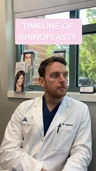 How long is rhinoplasty recovery?Rhinoplasty recovery usually needs about 1 week off work or school, according to Mayo Clinic’s October 2024 page, while MedlinePlus says the final result may take a year or longer.
 What is the first week after rhinoplasty like?The first week after rhinoplasty can involve supports, congestion, mouth breathing, drainage and bruising, according to ASPS, UCSF’s November 2022 recovery page and Mayo Clinic’s October 2024 page.
 When is the cast removed after rhinoplasty?University of Utah surgeon Cori Agarwal describes rhinoplasty splint removal at 5–7 days in her February 2026 interview, while MedlinePlus describes a cast or splint for 1–2 weeks.
- What is the rhinoplasty swelling timeline by month?A 2016 Yale study modeled rhinoplasty edema resolution at approximately two-thirds in month 1, 95% at month 6 and 97.5% at 1 year in 40 selected primary open-rhinoplasty patients with 146 photographs.
 Why is the tip still swollen after rhinoplasty?The tip can remain swollen for months after rhinoplasty, and the last small amount can take about a year, according to Cori Agarwal’s University of Utah interview updated February 2026.
 When can I breathe through my nose after rhinoplasty?Nasal breathing can be impaired for several weeks after rhinoplasty and improve as swelling recedes, according to UCSF, while Stanford says internal splints can temporarily obstruct breathing until removal at about 1 week.
- How should I sleep after rhinoplasty?Johns Hopkins advises keeping the head elevated when sleeping for the first 3 days after rhinoplasty, while Mayo Clinic says to rest with the head higher than the chest to reduce swelling and bleeding.
- When can I wear glasses after rhinoplasty?Mayo Clinic’s October 2024 rhinoplasty instructions say not to rest eyeglasses or sunglasses on the nose for at least 4 weeks.
- When can I exercise after rhinoplasty?Exercise dates after rhinoplasty differ: UCSF’s November 2022 page says wait 2 weeks for strenuous activity, while the verified Cleveland Clinic comparison gives 4–6 weeks for light exercise.
 When can I work and go out after rhinoplasty?Mayo Clinic’s October 2024 FAQ suggests about 1 week off work or school after rhinoplasty, and Utah’s February 2026 interview places nonstrenuous work around a week and usual life between weeks 1 and 3.
- How painful is rhinoplasty recovery?Rhinoplasty pain needs an individual plan: a 2018 US study of 62 patients found mean use of 8.7 prescribed hydrocodone-acetaminophen tablets, but Johns Hopkins says uncontrolled pain warrants immediate contact with the surgical team.
- How long does numbness last after rhinoplasty?Tip numbness can last several months after rhinoplasty, according to MedlinePlus, while Mayo Clinic’s October 2024 page lists permanent numbness in and around the nose as a possible risk without an incidence estimate.
- When will I see the final rhinoplasty result?Rhinoplasty contour refinement can take up to 1 year according to ASPS, and MedlinePlus says final results may take a year or longer.
- How long should I wait for revision rhinoplasty?Mayo Clinic’s October 2024 page says to wait at least 1 year for follow-up rhinoplasty because the nose can continue changing.
- What are the complication rates after rhinoplasty?The 2017 CosmetAssure study reported 37 major complications among 4,978 aesthetic rhinoplasty patients, or 0.7% as reported, but it counted only events requiring an emergency visit, admission or reoperation within 30 days.
- What is normal after rhinoplasty, and when should I call?Call the surgical team immediately for fever, excessive bleeding, uncontrolled pain, rash or visual disturbance after rhinoplasty, according to Johns Hopkins.
Rhinoplasty recovery
How long is rhinoplasty recovery?
Rhinoplasty recovery usually needs about 1 week off work or school, according to Mayo Clinic’s October 2024 page, while MedlinePlus says the final result may take a year or longer. The Aesthetic Society describes about 2 weeks for initial recovery. Those sources are talking about different milestones, so the comparisons below keep time off, removal appointments and contour refinement separate. You can be ready for a quiet workday while your nose still looks swollen and your breathing is still changing.
Each source’s recovery clock
Cori Agarwal’s University of Utah interview, updated February 2026, describes splint removal at 5–7 days and nonstrenuous work around a week. It also describes usual life returning between the first and third week. None of these educational pages gives a measured patient denominator for its schedule. Start by describing your actual job, commute, glasses and home responsibilities. Ask which milestone your surgeon means when they say recovery, and allow room for follow-up appointments rather than booking every commitment around cast removal.
“For my rhinoplasty, what dates should I plan for time off, support removal, public appearances and later result review?”
Rhinoplasty recovery
What is the first week after rhinoplasty like?
The first week after rhinoplasty can involve supports, congestion, mouth breathing, drainage and bruising, according to ASPS, UCSF’s November 2022 recovery page and Mayo Clinic’s October 2024 page. ASPS says to arrange help for at least the first night. A cast or splint can be visible outside while internal swelling or supports make the nose feel blocked. UCSF describes dry mouth and throat and disrupted sleep when early congestion prevents nasal breathing. A little bleeding mixed with mucus or old blood for a few days is described by Mayo.
What can make the first week difficult
ASPS describes external and internal supports. UCSF’s November 2022 page describes mouth breathing, dry mouth or throat and disrupted sleep when the nose is congested.
Mayo’s October 2024 page describes a little bleeding with mucus and old blood for a few days after surgery or dressing removal. Ask your team how to change the drip dressing and what amount needs a call.
The Aesthetic Society says most swelling and bruising improve in 10–14 days, with severe bruising possibly lasting 3 weeks. Mayo separately describes eyelid discoloration lasting 2–3 weeks.
ASPS asks you to arrange a ride and someone to stay at least the first night. A sore throat, poor sleep and medication effects can matter even when the nose itself is not very painful.
Patients describe different parts as the hard part. A Glamour writer describes a sore throat and an inconvenient sleeping position; replies in a California rhinoplasty-plus-septoplasty diary describe throat discomfort despite little nasal pain. These accounts were checked October 16, 2026 and do not establish how often symptoms occur. Keep your discharge instructions and contact numbers within reach of the person helping you. Excessive bleeding or uncontrolled pain belongs with an immediate call to the surgical team, not a comparison with another person’s photograph.
“Which first-week symptoms do you expect after my operation, and which changes should make my helper call immediately?”
Rhinoplasty recovery
When is the cast removed after rhinoplasty?
University of Utah surgeon Cori Agarwal describes rhinoplasty splint removal at 5–7 days in her February 2026 interview, while MedlinePlus describes a cast or splint for 1–2 weeks. Packing and internal splints have their own schedules. The Aesthetic Society gives a week to 10 days for external splint and bandage removal, and Mayo says about a week. These educational schedules have no measured patient denominator. Ask your team to name each device, where it sits and who will remove it.
Outside support and inside support are different
Drawing and comparison sources: MedlinePlus, reviewed 2025-02-05MedlinePlus, reviewed 2025-04-03University of Utah Health, updated 2026-02-12; originally published 2019-09-09American Society of Plastic Surgeons, page date not found; accessed 2026-10-16The Aesthetic Society, page date not found; accessed 2026-10-16Mayo Clinic, 2024-10-02Otolaryngology--head and neck surgery : official journal of American Academy of Otolaryngology-Head and Neck Surgery, 2017
External support, packing and internal splints have different dates
Packing is not universal. The Aesthetic Society says patients will have it, but Mayo’s FAQ says its practice does not pack noses, and the 2017 rhinoplasty guideline recommends against routine packing with or without septoplasty. An employee’s revision diary from a San Francisco practice describes uncomfortable internal stent removal and later work with swelling; employment makes it a promotional account. Removing a support can feel like progress without ending congestion or revealing the final contour. Do not remove, loosen or reapply a support based on a video.
“Will I have an external cast, internal splints, packing or removable stitches, and who removes each on what date?”
SourcesMedlinePlus, packing rangeMedlinePlus, septal numbnessUniversity of Utah Health, sleep positioningAmerican Society of Plastic Surgeons, swelling fluctuationThe Aesthetic Society, activityMayo Clinic, risk breathing dissatisfactionOtolaryngology--head and neck surgery : official journal of American Academy of Otolaryngology-Head and Neck Surgery, guideline packingrecovery-W03@ericanic0le
Rhinoplasty recovery
What is the rhinoplasty swelling timeline by month?
A 2016 Yale study modeled rhinoplasty edema resolution at approximately two-thirds in month 1, 95% at month 6 and 97.5% at 1 year in 40 selected primary open-rhinoplasty patients with 146 photographs. The baseline was the first postoperative visit at 1–2 weeks, not the preoperative nose. These are fitted total-nose volume estimates, not a promise about an individual tip, a closed operation or revision surgery. ASPS separately says swelling can fluctuate and be worse in the morning during the first postoperative year.
The bridge and tip can settle on different clocks
First weeks
Following months
A year or longer
- First weeks
ASPS says initial swelling subsides within weeks. Highlighted regions locate discussion areas, not measured swelling.
- Following months
ASPS says swelling can fluctuate and be worse in the morning during the first year.
- A year or longer
MedlinePlus says tip swelling and numbness can last months, and final results may take a year or longer.
Rhinoplasty Recovery | American Society of Plastic SurgeonsRhinoplasty: MedlinePlus Medical Encyclopedia
Schematics show anatomy and discussion areas, not measurements, a surgical plan, measured swelling reduction or a predicted result. Repeated profiles keep the same contour.
Drawing and comparison sources: American Society of Plastic Surgeons, page date not found; accessed 2026-10-16UCSF, 2022-11-14Plastic and reconstructive surgery, 2016Cleveland Clinic, 2022-11-03
Swelling by month, with the measurement kept beside it
Cleveland Clinic’s November 2022 education page describes about 90% resolution at 3 months without a measured denominator or traceable cohort. That figure cannot be validated by borrowing Yale’s different model. UCSF’s 2022 page also contains both 4–6-week mild-swelling language and months-to-a-year refinement language. A California patient source describes a pleasing profile alongside front-view swelling; its selected photographs do not diagnose another nose. Record concerns for your surgeon at the requested intervals rather than calculating an expected percentage from a selfie.
“Which swelling changes do you expect in my bridge and tip at each review, and what change should bring me in sooner?”
Rhinoplasty recovery
Why is the tip still swollen after rhinoplasty?
The tip can remain swollen for months after rhinoplasty, and the last small amount can take about a year, according to Cori Agarwal’s University of Utah interview updated February 2026. MedlinePlus also names months of tip swelling and numbness and a final result taking a year or longer. These are educational descriptions without a patient denominator. The tip deserves its own follow-up discussion even when bruises have faded or the bridge looks more defined. The drawing identifies the tip and dorsum so you can describe exactly what you mean.
Point to the area you mean
- Dorsum / bridge
ASPS describes reshaping nasal bone and cartilage. This profile labels the bridge without an ideal contour.
- Tip
The external tip is shown separately from the internal partition. Graft selection is specific to the operation.
- Septum
Mayo describes the partition between nasal passages. The dashed side-view region is a schematic cutaway.
Rhinoplasty Procedure Steps | American Society of Plastic SurgeonsRhinoplasty - Mayo Clinic
Schematics show anatomy and discussion areas, not measurements, a surgical plan, measured swelling reduction or a predicted result. Repeated profiles keep the same contour.
Drawing and comparison sources: MedlinePlus, reviewed 2025-02-05University of Utah Health, updated 2026-02-12; originally published 2019-09-09UCSF, 2022-11-14Facial plastic surgery : FPS, 2026Facial plastic surgery : FPS, 2026
Why the tip needs its own conversation
Cori Agarwal’s University of Utah interview, updated February 2026, describes boggy tip skin and the last small amount of swelling taking about a year.
MedlinePlus describes months of tip swelling and numbness, and a final result taking a year or longer. A sharp side profile does not establish that the front view has settled.
UCSF’s November 2022 page names skin thickness, technique, bruising tendency, revision status and combined procedures as recovery influences. It gives no multiplier for thick skin or revision.
Skin thickness, elasticity and support affect tip definition in the reviewed primary-rhinoplasty literature. A photograph cannot distinguish swelling from a structural concern or tell you whether taping is appropriate.
UCSF names skin thickness, technique, revision status, bruising tendency and combined procedures as influences on recovery. The literature also discusses skin elasticity and the structures supporting tip definition. None supplies a reliable extra number of months to add for your skin or a revision. Persistent fullness, unevenness or concern deserves an examination; the fact that swelling can last a long time does not prove that a particular change is harmless. Ask before copying taping, massage, supplements or medication from another patient.
“Is the tip change I am noticing expected swelling, and how will you assess it rather than assuming it will settle?”
Rhinoplasty recovery
When can I breathe through my nose after rhinoplasty?
Nasal breathing can be impaired for several weeks after rhinoplasty and improve as swelling recedes, according to UCSF, while Stanford says internal splints can temporarily obstruct breathing until removal at about 1 week. Mayo also names swelling and splints as causes of stuffiness. These are institutional instructions, not a measured timeline for every patient. If septal work was part of your operation, ASPS says early swelling can settle within weeks while the full septoplasty benefit takes a few months.
Inside the nose, the septum divides the passages
Internal partition
Septal work
- Internal partition
ASPS describes straightening and repositioning the septum. This transverse cutaway shows the partition and two passages, not an airflow measurement.
- Septal work
The straighter partition illustrates the aim of septal work, not a promised result. Septoplasty may be done alone or with rhinoplasty. Nasal valve dysfunction can require different treatment; septal work does not substitute for valve correction.
Septoplasty | American Society of Plastic SurgeonsPosition Statement: Nasal Valve Repair - American Academy of Otolaryngology-Head and Neck Surgery (AAO-HNS)
Schematics show anatomy and discussion areas, not measurements, a surgical plan, measured swelling reduction or a predicted result. Repeated profiles keep the same contour.
Drawing and comparison sources: Stanford Health Care, page date not found; accessed 2026-10-16Johns Hopkins Medicine, page date not found; accessed 2026-10-16UCSF, 2022-11-14UCSF, page date not found; accessed 2026-10-16American Society of Plastic Surgeons, page date not found; accessed 2026-10-16Mayo Clinic, 2024-10-02Cleveland Clinic, 2025-03-27
Congestion, splints and a later airway assessment
Stanford’s undated nasal-surgery instructions describe temporary breathing difficulty from plastic internal splints, usually removed at about 1 week. External cast removal may be a different event.
Mayo’s October 2024 page says swelling or splints can cause stuffiness. UCSF describes nasal breathing impaired for several weeks and improving as swelling recedes.
Stanford explains saline’s role in washing away crusts and dried blood. Johns Hopkins says avoid blowing for 2–3 weeks after rhinoplasty; Cleveland’s March 2025 septoplasty page says the first 1–2 weeks. Ask for your own instructions.
Cleveland’s septoplasty page says trouble breathing warrants immediate provider contact. Describe whether the problem is a blocked nose, worsening airflow or trouble breathing more generally; do not diagnose it from someone else’s diary.
The internal partition shown below is different from the outside bridge and tip. Removing the external cast does not establish that internal swelling has resolved. Ask how you should clean the nose and when you may blow it: Johns Hopkins gives 2–3 weeks after rhinoplasty, while Cleveland’s separate septoplasty page gives 1–2 weeks. Do not choose between them yourself. Contact the surgical team promptly for worsening airflow; Cleveland’s septoplasty page specifically calls for immediate provider contact for trouble breathing. A better-looking nose does not prove a satisfactory airway.
“What congestion do you expect after my exact operation, and when will you examine my breathing if it is not improving?”
Rhinoplasty recovery
How should I sleep after rhinoplasty?
Johns Hopkins advises keeping the head elevated when sleeping for the first 3 days after rhinoplasty, while Mayo Clinic says to rest with the head higher than the chest to reduce swelling and bleeding. Agarwal’s February 2026 Utah interview describes extra pillows behind the back or a recliner during early peak swelling. These educational sources do not establish one pillow angle or one number of nights for everyone. Ask your surgeon to demonstrate the position they want and explain when you can change it.
Sleeping position, source by source
UCSF describes dry mouth, throat dryness and disrupted sleep from early mouth breathing. That can make a home setup feel uncomfortable even when it follows the written plan. Tell your team if you normally sleep on your side, share a bed, use sleep equipment or cannot comfortably elevate your head. The Glamour diary’s awkward sleeping position is a reminder to rehearse the setup, not evidence that you need the same products. Ask the team about congestion or inability to rest rather than changing supports on your own.
“What sleeping position and number of nights do you want for me, and how should I handle my usual sleep equipment and congestion?”
Rhinoplasty recovery
When can I wear glasses after rhinoplasty?
Mayo Clinic’s October 2024 rhinoplasty instructions say not to rest eyeglasses or sunglasses on the nose for at least 4 weeks. The Aesthetic Society separately says altered nasal bones may require delayed wear or support such as tape, without one shared date. These instructions are not based on a measured patient denominator. Ask about the operation planned for your bridge and bring your frames to the appointment. A cast-removal date does not automatically answer when your glasses may press on the nose.
Make a plan for glasses before surgery
Do not rest eyeglasses or sunglasses on the nose for at least 4 weeks. At least is a lower limit in Mayo’s instructions, not automatic permission on that date.
When nasal bones were altered, glasses may need to be delayed or supported with tape. The page does not give everyone the same return date.
Bring your actual frames and describe reading, driving and protective equipment needs. Ask the surgeon to show you an approved support method before you need it at home.
An external splint coming off does not establish that the bridge can take frame pressure. Contact lenses, sunglasses and occupational protection each need a specific answer from your team.
Plan around the tasks you actually need vision for, including reading medication labels, getting to follow-up, commuting and wearing occupational eye protection. Ask the surgeon to demonstrate any approved support and tell you when to stop using it. Do not assume contact lenses or a different frame solve the problem without asking. If a support irritates the skin or your nose hurts under the frames, contact the office for instructions. The figure separates Mayo’s stated lower limit from the Aesthetic Society’s individualized bone-work guidance.
“How will I use my glasses and required eye protection after my operation, and when may they rest directly on my nose?”
Rhinoplasty recovery
When can I exercise after rhinoplasty?
Exercise dates after rhinoplasty differ: UCSF’s November 2022 page says wait 2 weeks for strenuous activity, while the verified Cleveland Clinic comparison gives 4–6 weeks for light exercise. Stanford asks patients to minimize physical activity for 2 weeks, and the Aesthetic Society describes most normal activities including exercise within 3 weeks while reserving strenuous exertion for surgeon clearance. These are different institutional protocols with no measured patient denominators, so averaging them would create a schedule none of the sources gave.
Activity dates disagree, and so do the activity labels
Describe the activity rather than asking only whether you can work out. Lifting at work, bending during childcare, a quiet walk, weight training and a sport with possible facial impact are different questions. Mayo’s FAQ uses broad most-activities and all-activities language; it cannot clear a particular sport. The separate Cleveland septoplasty calendar also cannot stand in for combined rhinoplasty. Ask what symptoms should stop an activity and who clears each step. A fit appearance and fading bruises do not measure the strength of healing structures.
“Which movements and exercises may I resume at each stage, and which need an examination or explicit clearance first?”
Rhinoplasty recovery
When can I work and go out after rhinoplasty?
Mayo Clinic’s October 2024 FAQ suggests about 1 week off work or school after rhinoplasty, and Utah’s February 2026 interview places nonstrenuous work around a week and usual life between weeks 1 and 3. The Aesthetic Society gives about 2 weeks for initial recovery. These educational schedules have no measured patient denominator and do not describe the same job or public setting. A remote desk task may ask less of you than a commute, required glasses, a customer-facing shift or physical work.
Which return are you planning?
- Calls and short tasksWill congestion, poor sleep or medication make this difficult even from home?
- Desk work or schoolMayo, October 2024: about 1 week off. Utah, February 2026: nonstrenuous work around 1 week.
- Public-facing work and social plansUtah: usual life between weeks 1 and 3. Aesthetic Society: most bruising improves in 10–14 days; severe bruising may last 3 weeks.
- Physical workWhich lifting, bending, protective-equipment and impact restrictions apply to my job?
Visible bruising may outlast a work estimate. The Aesthetic Society says most bruising improves in 10–14 days but severe bruising may last 3 weeks; Mayo describes eyelid discoloration for 2–3 weeks and minor bruising of about a week in its FAQ. A practice employee’s diary describes working with swelling, which is not an independent return-to-work standard. MedlinePlus’s separate septoplasty discharge sheet bars driving for at least 24 hours after anesthesia; that minimum does not clear later driving while impaired by medication or symptoms.
“Given my commute, glasses, job duties and social plans, what time off and restrictions should I put in writing?”
Rhinoplasty recovery
How painful is rhinoplasty recovery?
Rhinoplasty pain needs an individual plan: a 2018 US study of 62 patients found mean use of 8.7 prescribed hydrocodone-acetaminophen tablets, but Johns Hopkins says uncontrolled pain warrants immediate contact with the surgical team. The study recorded self-reported use in Texas and Michigan during February–September 2016 and included primary and revision patients. It does not establish a pain score, a dose to take or how many tablets you should receive. Side effects belong in the same conversation as pain relief.
Pain relief and side effects are separate parts of the plan
62 rhinoplasty patients in Texas and Michigan, studied February–September 2016, reported a mean of 8.7 hydrocodone-acetaminophen tablets used. This specific self-reported regimen is not a dose or prescription recommendation.
Drowsiness was reported by 22 of 62 and nausea by 7 of 62. These are medication-related reports, not a surgical complication rate or a prediction of your needs.
A patient account tied to a Miami practice describes nausea as the difficult part of the first evening. Replies in a California combined-surgery diary describe throat discomfort despite little nose pain. Both were partially read sources checked October 16, 2026.
Johns Hopkins lists uncontrolled pain as a reason to contact the surgical team immediately. Ask whom to call if you cannot tolerate the prescribed medicine or cannot keep it down.
In that same study, 22 of 62 patients reported drowsiness and 7 of 62 reported nausea. Patient accounts make the distinction concrete: a Miami-context rhinoplasty account emphasizes nausea on the first evening, while a California combined-surgery diary emphasizes throat discomfort despite little nose pain. Neither can predict your experience. Before surgery, ask about the medication plan, interactions, nausea, safe storage and whom to call if relief is inadequate. Do not add another person’s supplement or prescription, and do not wait out uncontrolled pain because a diary described an easy recovery.
“What is my pain and nausea plan, and who should I contact immediately if it does not control symptoms or causes side effects?”
Rhinoplasty recovery
How long does numbness last after rhinoplasty?
Tip numbness can last several months after rhinoplasty, according to MedlinePlus, while Mayo Clinic’s October 2024 page lists permanent numbness in and around the nose as a possible risk without an incidence estimate. The sources do not supply a measured patient denominator or a reliable percentage for sensation returning by a particular month. Describe the exact area, when you noticed the change and whether it is improving. A numb tip and altered upper-tooth sensation after septal work are different details for your surgeon.
Which area is numb, and what evidence is available?
MedlinePlus’s separate septoplasty discharge guidance also describes tip numbness taking several months to resolve. ASPS names temporary upper-gum or tooth numbness among septoplasty risks, and Cleveland lists usually temporary nose or tooth numbness. Those descriptions do not diagnose a spreading or worsening symptom. Contact your team when sensation changes concern you, and use their urgent instructions if pain, bleeding, breathing or other warning symptoms occur with it. The absence of a numerical incidence is a limit of these sources, not a reason to promise complete recovery of feeling.
“Which numb areas do you expect after my surgery, and what change or lack of improvement should prompt an examination?”
Rhinoplasty recovery
When will I see the final rhinoplasty result?
Rhinoplasty contour refinement can take up to 1 year according to ASPS, and MedlinePlus says final results may take a year or longer. Mayo Clinic’s October 2024 page says most swelling is gone within a year but lifelong nasal changes make an exact final-result date difficult. These are educational descriptions, not a measured deadline for every patient. Swelling can fluctuate during the first year, including in the morning according to ASPS, so a single early photograph cannot settle the question.
A settled result has more than one measure
ASPS says refinement can take up to 1 year, and swelling can fluctuate or be worse in the morning during that first year. Compare progress at the follow-up intervals your surgeon requests.
MedlinePlus says final results may take 1 year or longer. Mayo’s October 2024 page says most swelling is gone within a year but lifelong changes make an exact final date difficult.
The FACE-Q validation work supports asking about appearance and adverse effects beyond photographs. Better airflow, a pleasing side view and feeling comfortable with your face are different outcomes to discuss.
A California closed-rhinoplasty account describes later satisfaction after an anxious intermediate phase. The earlier posts were deleted and cannot be reconstructed. This partially read account, checked October 16, 2026, does not establish that every concern will fade.
Discuss the front, side, base, breathing and how you feel about the change. FACE-Q validation supports asking about appearance and adverse effects beyond photographs. A California closed-rhinoplasty account reports later satisfaction after an anxious intermediate period, but its earlier deleted posts cannot be reconstructed and its outcome does not establish that every concern resolves. If you are unhappy, bring the specific concern to follow-up now. Waiting for contour refinement should still include assessment and communication, especially when function and appearance seem to be moving in different directions.
“How will we assess my appearance, breathing and satisfaction over time, and when would you consider the result settled enough to discuss a correction?”
Rhinoplasty recovery
How long should I wait for revision rhinoplasty?
Mayo Clinic’s October 2024 page says to wait at least 1 year for follow-up rhinoplasty because the nose can continue changing. That is a timing statement for another operation, not a reason to delay reporting symptoms or dissatisfaction. The separate 2016 three-state database study counted later nasal operations over at least 3 years; its revision figures do not say when a particular patient should undergo correction. Its broad surgical codes and inclusion of patients aged 13 and older also prevent treating the overall figure as adult cosmetic-only risk.
Revision timing and revision counts answer different questions
The comparisons preserve the broad primary group, cosmetic-diagnosis subgroup and secondary-surgery subgroup. A coded repeat operation does not count every unhappy patient, every symptom or every office treatment. Revision also cannot be assigned a universal extra recovery duration: the verified secondary-recovery review discusses swelling and scar care without an abstract-based comparative timeline. Ask for an examination, an explanation of what might change with time and a written account of any proposed correction and fees. Urgent bleeding, breathing problems or uncontrolled pain still need immediate attention.
“What should we assess now, what may change with more healing, and what timing and charges would apply if you recommend revision?”
Rhinoplasty recovery
What are the complication rates after rhinoplasty?
The 2017 CosmetAssure study reported 37 major complications among 4,978 aesthetic rhinoplasty patients, or 0.7% as reported, but it counted only events requiring an emergency visit, admission or reoperation within 30 days. Its May 2008–May 2013 cohort does not measure every minor symptom, later contour concern, breathing problem or future revision. The longer-term practice series and review below use different definitions and follow-up. None is a personal risk estimate, and their percentages should not be added or averaged.
Complications, dissatisfaction and another operation are different endpoints
A 2013 US practice review of 369 cosmetic cases separately reported complications, dissatisfaction and revision. A 2020 review summarized ranges across 36 studies of primary aesthetic, functional and combined surgery, with no common follow-up or patient total in its abstract. These differences matter when someone quotes a single safety percentage. Permanent numbness and septal perforation are also listed risks on Mayo’s page without incidence. Ask your surgeon which complications they track, for what operations, over what period and how they manage them. A low reported rate never decides whether a current symptom needs assessment.
“For patients having my planned operation, what complications do you track, over what follow-up, and how would you treat or arrange care for them?”
Rhinoplasty recovery
What is normal after rhinoplasty, and when should I call?
Call the surgical team immediately for fever, excessive bleeding, uncontrolled pain, rash or visual disturbance after rhinoplasty, according to Johns Hopkins. Mayo Clinic’s October 2024 page describes a little blood and mucus for a few days, but that description cannot classify your bleeding at home. The separate Cleveland Clinic septoplasty instructions, updated March 2025, also call for immediate provider contact for heavy uncontrollable nosebleeding, confusion, severe headaches, trouble breathing, worsening pain unresponsive to medication or its specified fever symptoms.
What is described in recovery, and when to call
- Contact the surgical team immediately
Johns Hopkins lists fever, excessive bleeding, uncontrolled pain, rash or visual disturbance after nose reshaping. Do not wait for a scheduled photograph review.
- After septoplasty, call the provider immediately
Cleveland Clinic, March 2025: heavy uncontrollable nosebleeding, confusion or disorientation, fever over 102°F or lasting 2 days, worsening pain unresponsive to medication, severe headaches or trouble breathing.
- Discuss the course of expected symptoms
Mayo, October 2024, describes a little blood and mucus for a few days. Ask your team how much is too much and how to report a change; a diary cannot classify your bleeding.
My written recovery plan
Cleveland’s fever wording is over 102°F or lasting 2 days; it belongs to that septoplasty source and is not a threshold for ignoring other symptoms after rhinoplasty. Ask for your own urgent list, after-hours number and destination if the team cannot be reached. Tell the team when the symptom started and how it has changed. The worksheet also records support-removal and later review appointments. ASPS asks patients to discuss how complications and dissatisfaction are handled; do not assume that a proposed correction includes every related charge.
“What symptoms mean I should contact you immediately, and where should I seek care if I cannot reach your team?”
My rhinoplasty recovery questions
Save questions for your consultation or follow-up. They stay in this browser.
Nothing saved yet. Tap Save to my list under any question.
Start with a short intake, pick your top 3 practices, and get Interactive Quotes back.
Near you
Practices that publish rhinoplasty results, and rhinoplasty pages for the cities and states Afters covers.
Planning time off for rhinoplasty?
Bring your work, glasses, home-help and follow-up needs into the consultation so your recovery plan covers your actual days.
How we researched rhinoplasty recovery
We used the corrected October 16, 2026 rhinoplasty research packet, institutional instructions, society pages, published studies and selected US patient accounts. Each timetable stays attached to its source. A patient diary informs a question; it does not establish an aftercare instruction.
Clinical evidence and dates
Mayo’s page is dated October 2024, UCSF’s recovery page November 2022, Cleveland’s rhinoplasty page November 2022 and its septoplasty page March 2025. Utah’s Agarwal interview was updated February 2026 from an older interview. Undated society and institutional pages remain undated. All were checked October 16, 2026. Educational pages have no measured patient denominator. Studies retain their patient or study counts, design and follow-up; reviews are not new independent cohorts.
What patients said
The packet retains 86 US sources, not 86 independent patients. It rendered 62 Reddit threads and partly read comments in 61; zero complete original comment trees were certified, so the full-thread reading requirement remains unmet. We use selected paraphrases, not quotations or symptom rates. Repeat diaries are not separate outcomes. The San Francisco diary is by a practice employee, the Glamour diary is a beauty writer’s account with product mentions, and practice-published interviews are selected marketing stories. Posting dates that were not established remain unknown.
Video selection and playback
Six KEEP videos are intended for this guide, including combined septorhinoplasty and turbinate treatment and surgeon explanations. Only uploaded videos with both Mux asset and playback identifiers render. The packet’s sampled-frame and caption review does not establish full-speed human audiovisual clearance or music rights. Suggested poster and share times still require the lead’s review. Personal supplement routines, painless recovery and early appearance are not treatment instructions or promises.
What these figures cannot answer
No averaged recovery deadline, personalized swelling percentage, extra-month multiplier for revision or thick skin, universal packing rule or routine taping regimen is inferred. We preserve Cleveland’s untraced educational swelling estimate beside its missing denominator and the different Yale model; its untraced revision estimate is not used as a population rate. Prices belong in the separate cost guide. A surgeon must assess your symptoms and clear your own activities.
This guide supports a conversation with the surgical team and cannot determine whether a current symptom is expected.
Sources
- Rhinoplasty - Mayo ClinicMayo Clinic · 2024
- Rhinoplasty (Nose Job Surgery) Recovery & AftercareThe Aesthetic Society · Accessed Oct 16, 2026
- Rhinoplasty Recovery Timeline: What To Expect From Surgery To Final Results | University of Utah HealthUniversity of Utah Health · Accessed Oct 16, 2026
- Rhinoplasty Recovery | American Society of Plastic Surgeons American Society of Plastic Surgeons · Accessed Oct 16, 2026
- Rhinoplasty: MedlinePlus Medical EncyclopediaMedlinePlus · Accessed Oct 16, 2026
- Rhinoplasty Preparation | American Society of Plastic Surgeons American Society of Plastic Surgeons · Accessed Oct 16, 2026
- Rhinoplasty | Johns Hopkins MedicineJohns Hopkins Medicine · Accessed Oct 16, 2026
- What to Expect from Rhinoplasty Recovery | OtolaryngologyUCSF · 2022
- Septoplasty - discharge: MedlinePlus Medical EncyclopediaMedlinePlus · Accessed Oct 16, 2026
- Clinical Practice Guideline: Improving Nasal Form and Function after Rhinoplasty.Otolaryngology--head and neck surgery : official journal of American Academy of Otolaryngology-Head and Neck Surgery · 2017
- Postoperative Edema Resolution following Rhinoplasty: A Three-Dimensional Morphometric Assessment.Plastic and reconstructive surgery · 2016
- Rhinoplasty (Nose Job): Surgery, Recovery, Before & AfterCleveland Clinic · 2022
- Postoperative Care to Ensure Optimal Tip Rhinoplasty Results.Facial plastic surgery : FPS · 2026
- Skin and Soft Tissue Management in Primary Rhinoplasty.Facial plastic surgery : FPS · 2026
- Nasal Surgery Postoperative Instructions | Stanford Health CareStanford Health Care · Accessed Oct 16, 2026
- Rhinoplasty San Francisco | UCSF Head and Neck SurgeryUCSF · Accessed Oct 16, 2026
- Septoplasty Recovery | American Society of Plastic Surgeons American Society of Plastic Surgeons · Accessed Oct 16, 2026
- Septoplasty: Procedure & RecoveryCleveland Clinic · 2025
- Opioid Use by Patients After Rhinoplasty.JAMA facial plastic surgery · 2018
- Septoplasty Risks and Safety | American Society of Plastic Surgeons American Society of Plastic Surgeons · Accessed Oct 16, 2026
- Development and Psychometric Evaluation of the FACE-Q Scales for Patients Undergoing Rhinoplasty.JAMA facial plastic surgery · 2016
- Revision Rates and Risk Factors of 175 842 Patients Undergoing Septorhinoplasty.JAMA facial plastic surgery · 2016
- Revision Rates and Risk Factors of 175 842 Patients Undergoing Septorhinoplasty.JAMA facial plastic surgery · 2016
- Optimizing Recovery in the Secondary Rhinoplasty Patient.Facial plastic surgery clinics of North America · 2026
- Cosmetic rhinoplasty: revision rates revisited.Aesthetic surgery journal · 2013
- Incidence and Preoperative Risk Factors for Major Complications in Aesthetic Rhinoplasty: Analysis of 4978 Patients.Aesthetic surgery journal · 2017
- Incidence of Postoperative Adverse Events after Rhinoplasty: A Systematic Review.Plastic and reconstructive surgery · 2020
- Rhinoplasty Questions | American Society of Plastic Surgeons American Society of Plastic Surgeons · Accessed Oct 16, 2026
- US patient account of front-view swelling and profile photographsPseudonymous patient, California · Accessed Oct 16, 2026
- US closed-rhinoplasty account of later satisfaction after swelling anxietyPseudonymous patient, California · Accessed Oct 16, 2026
- US patient account of nausea during early rhinoplasty recoveryPseudonymous patient, Miami practice context · Accessed Oct 16, 2026
- US combined rhinoplasty and septoplasty diary, throat discomfortPseudonymous patient replies in partner-posted diary · Accessed Oct 16, 2026
- Revision rhinoplasty diary by a practice employeePractice employee diary, San Francisco · Accessed Oct 16, 2026
- First-person rhinoplasty diary by a beauty writerGlamour, Manhattan surgery · Accessed Oct 16, 2026
- Rhinoplasty recovery: dr.jeff_markeyTikTok · @dr.jeff_markey · Oct 11, 2022
- Rhinoplasty recovery: ericanic0leTikTok · @ericanic0le · Aug 20, 2023
- Rhinoplasty recovery: ericanic0leTikTok · @ericanic0le · Aug 22, 2023
- Rhinoplasty recovery: Azadeh “AzMenaz” AfshariYouTube/Azadeh “AzMenaz” Afshari · 2016
- Rhinoplasty recovery: Dr. Philip Miller, MD, FACSYouTube/Dr. Philip Miller, MD, FACS · 2014
- Rhinoplasty recovery: Yael HalaasYouTube/Yael Halaas · 2019