Eyelid surgery recovery: How long is eyelid surgery recovery?
 Felipe LeeCo-founder, Afters · Updated October 1, 2026
Eyelid surgery (blepharoplasty) recovery time, week by week: how long until you look normal, bruising and swelling, blurry vision, dry eyes, stitches, contact lenses and makeup, driving, work and exercise, scars, a second surgery, and when to call your surgeon. Built from ASPS, Mayo Clinic, Cleveland Clinic, Johns Hopkins, AAFPRS, ASOPRS, the AAO and practice recovery guides.
- Presentable in public, ASPS
- 10–14days
- Stitches out, by page
- 3–14days
- Contact lenses, by page
- 1–3weeks
- Final healing, ASPS and Cleveland Clinic
- A fewmonths
What people ask about eyelid surgery recovery
Eighteen questions, from the first morning to the years after. When pages disagree, each one is named, and every answer ends with something to ask your surgeon.
 How long is eyelid surgery (blepharoplasty) recovery?Cleveland Clinic says most people feel good enough to go back to their usual routine a week or two after eyelid surgery (blepharoplasty), and that complete recovery usually takes a few months.
 How long until I look normal after eyelid surgery?Bruising and swelling after eyelid surgery lessen over about 10 to 14 days, Mayo Clinic says, but EyeWiki, the American Academy of Ophthalmology’s wiki, says swelling is most noticeable for the first several weeks and complete healing can take several months or more.
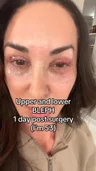
 What happens on day 1, 3, 7, 14, 30 and 90 after eyelid surgery?One San Diego practice, writing about upper and lower lids, says the most visible swelling and bruising come on days 1 to 3 after eyelid surgery, swelling softens and stitches commonly come out on days 4 to 7, and many people return to work or social settings at about two weeks.
 Is recovery different after upper, lower or four-lid eyelid surgery?No page we read gives a separate recovery timeline for four-lid eyelid surgery, and the pages that name the lids give timelines for upper lids or for lower lids, not a comparison.
 What will I see and feel in the first days after eyelid surgery?Mayo Clinic says that after eyelid surgery you might temporarily have blurred vision from the lubricating ointment, watering eyes, light sensitivity, double vision, puffy and numb eyelids, swelling and bruising like black eyes, and some pain or discomfort.
- How should I sleep, and should I use ice after eyelid surgery?Mayo Clinic says to sleep with your head raised higher than your chest for a few days after eyelid surgery, and to use ice packs for 10 minutes every hour the night after surgery and 4 to 5 times the next day.
- What drops, ointment and sunglasses will I need after eyelid surgery?The AAO’s outline for upper blepharoplasty says antibiotic or steroid and antibiotic ointment may be applied twice a day to the stitches and into the eyes at night, with artificial tears also recommended.
 When do the stitches come out after eyelid surgery?Pages put stitch removal anywhere from 3 to 14 days after eyelid surgery.
- How long do dry eyes last after eyelid surgery?Cleveland Clinic says your eyes may feel dry for a few weeks after eyelid surgery, and Johns Hopkins says they may feel sticky, dry or itchy for a week or more.
 What if I bruise easily after eyelid surgery?No page we read gives a recovery timeline for people who bruise easily after eyelid surgery, only one range for everyone, such as about 10 to 14 days from Mayo Clinic.
 Where are eyelid surgery scars, and when do they fade?Scars from eyelid surgery may take months to fade, Mayo Clinic says, and one San Diego practice says scar maturation can continue six months to a year.
- When can I wear contact lenses, glasses and makeup after eyelid surgery?Pages put contact lenses back in about 1 to 3 weeks after eyelid surgery.
- When can I drive, use screens and go back to work after eyelid surgery?Remagin, a practice writing about upper lids, says most patients return to work in 7 to 10 days after eyelid surgery, and a lower lid practice says to expect one to two weeks off.
- When can I exercise and lift after eyelid surgery?Mayo Clinic says to avoid anything strenuous for a week after eyelid surgery, including heavy lifting, swimming, jogging and aerobics, and MyHealth Alberta, a Healthwise handout in Canada, says to avoid strenuous activity for 2 weeks.
- Who will I need to help me at home after eyelid surgery?Cleveland Clinic says to arrange for someone to drive you to and from eyelid surgery and, if possible, someone to stay with you for the first night or two.
- What surprises people about eyelid surgery recovery?In 12 of the 47 patient accounts we read about eyelid surgery, people said they had little or no pain, and in 10 they said their face looked much worse in the first week than they expected.
- When should I call my surgeon after eyelid surgery?Call your surgeon right away.
 How long do eyelid surgery results last, and can I need a second surgery?No source we read gives a measured recurrence rate for eyelid surgery, and the years that two practice pages give, about 7 for upper lids at one and 5 to 10 at another, cite no study.
The timeline
How long is eyelid surgery (blepharoplasty) recovery?
Cleveland Clinic says most people feel good enough to go back to their usual routine a week or two after eyelid surgery (blepharoplasty), and that complete recovery usually takes a few months. ASPS says most patients are presentable to the public in 10 to 14 days.
Each part of eyelid surgery recovery keeps its own time
The pages differ on what “back to normal” means. The AAO’s outline for upper blepharoplasty, written for clinicians, says patients may usually resume normal activities within 24 to 48 hours, and Mayo Clinic says bruising and swelling lessen slowly over about 10 to 14 days. Some timelines are for upper lids, some for lower lids and many don’t say, so each one here names its source and its lids. Your surgeon sets your own dates.
“Which dates should I plan around for work, driving, exercise and being seen in public after my operation?”
The timeline
How long until I look normal after eyelid surgery?
Bruising and swelling after eyelid surgery lessen over about 10 to 14 days, Mayo Clinic says, but EyeWiki, the American Academy of Ophthalmology’s wiki, says swelling is most noticeable for the first several weeks and complete healing can take several months or more. ASPS says final healing may take a few months.
When swelling and healing settle, by page
One San Diego practice says fine swelling and incision maturation continue for 2 to 3 months, and MyHealth Alberta, a Healthwise handout in Canada, says the look may keep improving for 1 to 3 months. In 10 of the 47 patient accounts we read, people said their face looked much worse in the first week than they expected, and 5 said the final result took months, not the two weeks many sites imply. One patient suggested asking how long you’ll look different, and not only how long it will hurt.
“How long will I look different, not only how long will it hurt, and what should I expect at two weeks, six weeks and three months?”
The timeline
What happens on day 1, 3, 7, 14, 30 and 90 after eyelid surgery?
One San Diego practice, writing about upper and lower lids, says the most visible swelling and bruising come on days 1 to 3 after eyelid surgery, swelling softens and stitches commonly come out on days 4 to 7, and many people return to work or social settings at about two weeks. The AAO’s outline for upper blepharoplasty adds that swelling may worsen over the first 24 hours.
Days 1, 3 and 7, by named page
- 1Day 1Home the same day, usually
- Outpatient, home the same day (Mayo Clinic)
- Swelling may worsen over the first 24 hours (AAO outline, upper lids)
- Ice packs 10 minutes every hour that night (Mayo Clinic)
- 2Day 3The most visible stretch
- Most visible swelling and bruising, days 1 to 3 (one San Diego practice, upper and lower lids)
- Frequent ice packs for the first 3 to 4 days (Klapper and Patrinely, a 2007 review)
- A low or panicky day in 7 of 47 patient accounts, between days 2 and 7
- 3Day 7Stitches, for many
- Stitches commonly out in the first week (one San Diego practice)
- Stitches in about a week (Cleveland Clinic)
- Contact lenses back at about a week (AAO outline, upper lids) or about two weeks (Mayo Clinic)
Days 14, 30 and 90, by named page
- 1Day 14Presentable, for many
- Presentable in 10 to 14 days (ASPS)
- Bruising and swelling lessen over about 10 to 14 days (Mayo Clinic)
- Many return to work or social settings (one San Diego practice, upper and lower lids)
- 2Day 30Swelling still there
- Swelling most noticeable for the first several weeks (EyeWiki)
- Strenuous exercise restricted 3 to 4 weeks (Remagin, upper lids)
- Working out again around weeks 4 to 6 (a practice in Austin, lower lids)
- 3Day 90Still settling
- The look may keep improving for 1 to 3 months (MyHealth Alberta, Canada)
- Numbness of upper lid skin and lashes typically resolves over 2 to 4 months (AAO outline)
- Final results over 3 to 6 months (Remagin, upper lids)
The pages we cite give day 30 and day 90 as ranges, not as days. The San Diego practice says fine swelling continues for 2 to 3 months, and Remagin, a practice writing about upper lids, says final results develop over 3 to 6 months. In 7 of the 47 patient accounts we read, people described an emotional dip or panic somewhere between days 2 and 7 over swelling, lumps or folds.
“What should day 3 and day 14 look like for my operation, and what would make you want to see me sooner?”
The timeline
Is recovery different after upper, lower or four-lid eyelid surgery?
No page we read gives a separate recovery timeline for four-lid eyelid surgery, and the pages that name the lids give timelines for upper lids or for lower lids, not a comparison. For upper lids, the AAO’s outline says patients may usually resume normal activities within 24 to 48 hours. For lower lids, a practice in Austin says most patients work out again around weeks 4 to 6.
Which lids each choice works on, and where it cuts
- Blue: the lid it works on
- Lemon: where the cut goes
- Upper eyelids
Touches. Extra skin, and sometimes a little fat or muscle, from the upper lid.
Cut. In the natural crease of the lid, so the scar sits in the fold.
- Lower eyelids
Touches. Fat bags and sometimes loose skin. Fat can be removed or moved.
Cut. Inside the lid, or in the skin just under the lashes. The inside route leaves no cut in the skin. Drawn dashed here because it is hidden.
- All four lids
Touches. Both upper and both lower lids in one operation. None of the sources read defines the term, so ask exactly what is planned.
Cut. Each pair has its own cut, as above.
What named pages say, by which lids they write about
Where the evidence does point somewhere, it’s at the eye’s surface. In one Indiana surgeon’s review of 892 cases, self-reported dry-eye symptoms (26.5%) and chemosis, swelling of the eye’s clear lining (26.3%), were higher with upper and lower surgery together, and a 2023 review says chemosis is common but usually temporary and much more common after lower lid surgery. Cleveland Clinic says surgery on both pairs takes closer to two hours. None of the pages we cite gives a recovery timeline for fat repositioning or for a canthopexy, and none defines four-lid surgery, so ask exactly what is planned.
“Which lids and which techniques are you planning for me, and what does recovery look like for that combination?”
The first days
What will I see and feel in the first days after eyelid surgery?
Mayo Clinic says that after eyelid surgery you might temporarily have blurred vision from the lubricating ointment, watering eyes, light sensitivity, double vision, puffy and numb eyelids, swelling and bruising like black eyes, and some pain or discomfort. Johns Hopkins says your eyes may feel sticky, dry or itchy for a week or more.
What the pages say you might notice
Blurred vision from the lubricating ointment, double vision and light sensitivity, temporarily (Mayo Clinic)
Watering, and sticky, dry or itchy for a week or more (Mayo Clinic, Johns Hopkins)
Puffy and numb (Mayo Clinic), and tight and sore (MyHealth Alberta, Canada). Numb upper lid skin and lashes are expected after upper blepharoplasty (AAO outline)
Swelling and bruising like black eyes (Mayo Clinic). Swelling may worsen over the first 24 hours (AAO outline, upper lids)
Discomfort that medication, cold compresses and ointment can control (ASPS)
ASPS says initial healing may include swelling, bruising, irritation, dry eyes and discomfort that medication, cold compresses and ointment can control. In 12 of the 47 patient accounts we read, people said they had little or no pain, and 2 said dry eye or blurry vision appeared or got worse. Two of the patient videos we reviewed, filmed on days 1 and 2, describe very blurry vision, and one of them also describes double vision on waking and says her vision was fine later that day.
“Which blurred vision, double vision or pain is expected, and which should make me call you right away?”
The first days
How should I sleep, and should I use ice after eyelid surgery?
Mayo Clinic says to sleep with your head raised higher than your chest for a few days after eyelid surgery, and to use ice packs for 10 minutes every hour the night after surgery and 4 to 5 times the next day. MyHealth Alberta, a Healthwise handout in Canada, says to keep your head up with 2 or 3 pillows for several days.
Each page’s dates for cold and sleeping raised
Up toA date from your surgeon
Other sources set the cold differently. Klapper and Patrinely, in a 2007 review, say head elevation, sleeping on your back and frequent ice packs for the first 3 to 4 days may limit the risk of bleeding behind the eye, and AAFPRS says cold compresses and head elevation aid healing. A 2025 review of 29 randomized trials of eyelid and nearby surgery found magnesium sulfate dressings worked better than ice packs for swelling, though cold compresses gave short-term relief. Cold helped in 11 of the 47 patient accounts we read, and 8 said sleeping raised helped.
“Do you want ice, cold compresses or neither, how often and for how many days, and how many nights should I sleep raised?”
The first days
What drops, ointment and sunglasses will I need after eyelid surgery?
The AAO’s outline for upper blepharoplasty says antibiotic or steroid and antibiotic ointment may be applied twice a day to the stitches and into the eyes at night, with artificial tears also recommended. Cleveland Clinic says your care team can suggest unmedicated ointment or drops for eyes that may feel dry for a few weeks.
What the pages mention for the weeks after
Antibiotic or steroid ointment twice a day to the stitches and at night in the eyes, with artificial tears (AAO outline, upper lids). Unmedicated ointment or drops for dryness (Cleveland Clinic)
Darkly tinted sunglasses and diligent sun protection until healing is complete (ASPS). Sunglasses on bright days for 1 year (MyHealth Alberta, Canada)
None on the eye for at least 2 weeks (MyHealth Alberta, Canada)
Avoided for 10 days (MyHealth Alberta, Canada)
5.2% developed contact dermatitis from post-op drops or ointment in one surgeon’s series of 424 laser patients, mostly with lower blepharoplasty
ASPS says to use diligent sun protection and darkly tinted sunglasses until healing is fully complete, and MyHealth Alberta says sunglasses on bright days for 1 year, no rubbing or pressure on the eye for at least 2 weeks and no hair coloring for 10 days. In one oculoplastic surgeon’s series of 424 patients who had CO2 laser on the lower lids, 82% of them with lower blepharoplasty at the same time, 5.2% developed contact dermatitis from the antibiotic drops or ointment prescribed afterward. Big sunglasses helped in 6 of the 47 patient accounts we read.
“Which drops and ointment will I use, how often and for how long, and what should I do if my skin or eyes react?”
The first days
When do the stitches come out after eyelid surgery?
Pages put stitch removal anywhere from 3 to 14 days after eyelid surgery. AAFPRS says permanent stitches come out three to five days after surgery, Cleveland Clinic says stitches stay in for about a week, and the AAO’s outline for upper blepharoplasty says nonabsorbable stitches come out 7 to 14 days after.
Each page’s dates for stitches
A rangeAboutUp to
MyHealth Alberta, a Healthwise handout in Canada, says removable stitches come out in 5 to 10 days, and AAFPRS says stitches from the inside-the-lid cut are invisible and often dissolve on their own. Stitches can open. At one Texas surgery center, 34 of 2,376 upper lids (1.4%, in 1,190 patients) had a wound open, at an average of 9 days, and male sex and a fast-absorbing plain gut stitch were the independent risk factors. One patient filmed at two weeks says her lids reacted to the stitches as they dissolved in week 1 and her surgeon removed the rest.
“Are my stitches dissolving or removable on each lid, and when and where will they come out?”
Eyes and healing
How long do dry eyes last after eyelid surgery?
Cleveland Clinic says your eyes may feel dry for a few weeks after eyelid surgery, and Johns Hopkins says they may feel sticky, dry or itchy for a week or more. No page we read says how long dry eye lasts when it doesn’t clear on its own, which is a gap in the research.
Dry eye studies that counted symptoms or tests early
Studies that compared with before surgery, or counted it later
Klapper and Patrinely say tear film changes generally improve by 4 to 6 weeks and that postoperative dry eye is the most common cause of temporary vision changes. Mild trouble closing the eyes usually resolves in several days to a few weeks, they say, and a lid position that hasn’t settled by 6 months may need surgery. Dry eye or trouble closing the eyes that lasted was the regret in 5 of the 47 patient accounts we read. The studies shown with this answer count different things in different people, so each one stands on its own and none is pooled.
“How will you check that my eyes close fully, what drops should I have ready, and what dry-eye or closing problem should I tell you about, and when?”
Eyes and healing
What if I bruise easily after eyelid surgery?
No page we read gives a recovery timeline for people who bruise easily after eyelid surgery, only one range for everyone, such as about 10 to 14 days from Mayo Clinic. In 4 of the 47 patient accounts we read, people described bruising that spread to the cheeks, lasted up to six weeks, or was worse in fair or easy-bruising skin.
When bruising is gone, by page
The AAO’s outline says bromelain and arnica may help minimize bruising but may also thin the blood and raise bleeding risk, and a 2025 review of 29 randomized trials of eyelid and nearby surgery found no significant benefit from either. That review found tranexamic acid the most consistently effective for bruising, and a 2025 analysis of five trials (594 participants, upper blepharoplasty) found it reduced bruising on days 1 and 7 and shortened reported recovery by about 0.72 days, with dosing and clot risks needing more study. Mayo Clinic, ASPS and ASOPRS say to avoid aspirin and anti-inflammatory drugs, and some supplements, around surgery as your surgeon directs. One patient filmed on day 5 after lower lid surgery says she bruises very easily and had yellowing bruises and little swelling, which is one account and not a timeline.
“I bruise easily. How long should I plan to look bruised, and which medicines and supplements do I stop, and when?”
Eyes and healing
Where are eyelid surgery scars, and when do they fade?
Scars from eyelid surgery may take months to fade, Mayo Clinic says, and one San Diego practice says scar maturation can continue six months to a year. Cleveland Clinic says upper lid cuts are made in the natural crease and are hidden when your eyes are open, and lower lid cuts sit just below the lash line or inside the lid.
Where the cuts go, and the layers that heal
- SkinThe lid’s outer layer. Extra upper-lid skin is what an upper blepharoplasty trims; a skin pinch trims a thin strip from the lower lid.
- Orbicularis muscleThe muscle layer under the skin (orbicularis oculi). Some operations remove a strip of it with the skin; studies compare skin only with skin and muscle.
- Orbital septumA thin sheet in front of the fat pads. A surgeon may open it to trim the fat behind it.
- Fat padsFat behind the septum. When it bulges forward it makes bags, and in the lower lid it can be taken out or moved.
- Levator muscle and tarsal plateThe muscle that lifts the upper lid. When it stretches or comes loose the lid edge droops, which is ptosis, a different operation. The tarsal plate is part of the lid’s back layer, with the lining.
- Inner liningThe lining of the lid, the conjunctiva. The inside-the-lid route goes through it.
- Upper lid cut, in the creaseThe cut follows the natural crease of the upper lid, so the scar sits in the fold. The extra skin comes out through it, and sometimes fat or muscle.
- Lower lid cut, inside the lidThe transconjunctival route goes through the inner lining, so there is no cut in the skin. The other route is a cut in the skin just under the lashes.
What pages say and what patients report
After eyelid surgery
- Scars may take months to fade (Mayo Clinic)
- Incisions mature over 2 to 3 months and scars over 6 months to a year (one San Diego practice)
- Numbness of upper lid skin and lashes typically resolves over 2 to 4 months (AAO outline)
- 4 said scars were hidden and faded sooner than they feared
- 4 said lids or scars stayed pink or red for months
- 3 said the lid, brow or forehead was numb
AAFPRS says stitches from the inside-the-lid cut are invisible and often dissolve on their own. The AAO’s outline says numbness of the upper lid skin and lashes is expected after upper blepharoplasty and typically resolves over 2 to 4 months, and Mayo Clinic says to protect your eyelid skin from the sun. In 4 of the 47 patient accounts we read, scars were hidden and faded sooner than people feared, and in 4 the lids or scars stayed pink or red for months. Silicone scar gel, gentle massage or sunscreen on scars came up in 5 of the 47 accounts.
“Where exactly will each cut be, what should I do for the scars and when, and what changes should I show you?”
Back to normal
When can I wear contact lenses, glasses and makeup after eyelid surgery?
Pages put contact lenses back in about 1 to 3 weeks after eyelid surgery. The AAO’s outline for upper blepharoplasty says about a week, Mayo Clinic says about two weeks, and Dr. Sukkar’s practice says about 2 to 3 weeks.
Each page’s dates for contact lenses, glasses and eye makeup
AboutAt least, then onwardA range
Klapper and Patrinely say people who wear contact lenses should expect to wear glasses for 1 to 3 weeks, and the AAO outline says lenses are put in and taken out by moving the lower lid. MyHealth Alberta says no contact lenses or eye makeup for about 2 weeks, and one San Diego practice says eye makeup can start once the incisions have sealed and the surface stitches are out, often around 7 to 10 days. One patient filmed at two weeks says her surgeon cleared her for makeup that week. Concealer once the stitches were out came up in 3 of the 47 patient accounts we read.
“When can I put contact lenses back in, when can I wear eye makeup and take it off, and should I plan on glasses until then?”
Back to normal
When can I drive, use screens and go back to work after eyelid surgery?
Remagin, a practice writing about upper lids, says most patients return to work in 7 to 10 days after eyelid surgery, and a lower lid practice says to expect one to two weeks off. MyHealth Alberta, a Healthwise handout in Canada, says most people are ready to go out in public and back to work in about 10 to 14 days. No page we read gives a number of days for driving, and Dr. Sukkar’s practice says it depends on safe vision rather than the calendar.
Four kinds of going back
- Working from homeLimit reading, computer work and TV for the first few days (MyHealth Alberta, Canada)
- Desk work7 to 10 days (Remagin, upper lids) · 1 to 2 weeks off (Dr. Panossian, lower lids)
- Seeing people10 to 14 days (ASPS · MyHealth Alberta, Canada)
- Lifting or physical workAsk for a date, and whether there’s a weight limit
Cleveland Clinic says you won’t be able to drive yourself to surgery, and MyHealth Alberta says to limit reading, computer work and TV for the first few days. Patients varied. One filmed on day 3 had already put in a light day at work, and another took a week and a half off. Your own date depends on what your job asks of your eyes and how public it is.
“When can I drive, work from home, go back to my desk and see people, given what my job asks of my eyes?”
Back to normal
When can I exercise and lift after eyelid surgery?
Mayo Clinic says to avoid anything strenuous for a week after eyelid surgery, including heavy lifting, swimming, jogging and aerobics, and MyHealth Alberta, a Healthwise handout in Canada, says to avoid strenuous activity for 2 weeks. The pages don’t agree, so each one keeps its name here.
Each page’s dates for exercise and lifting
Up toAboutA range
Practices say longer. Remagin says strenuous exercise is restricted about 3 to 4 weeks after upper lids, a practice in Austin says most patients work out again around weeks 4 to 6 after lower lids, and Dr. Sukkar’s practice says light exercise may return around week 2 if cleared. ASOPRS says to minimize strenuous activity for several days, and Klapper and Patrinely say avoiding bending and heavy lifting for the first week may limit the risk of bleeding behind the eye.
“When can I walk, lift, swim and run, and is there a weight limit or a date for flying?”
Help and warnings
Who will I need to help me at home after eyelid surgery?
Cleveland Clinic says to arrange for someone to drive you to and from eyelid surgery and, if possible, someone to stay with you for the first night or two. ASPS says to arrange a driver and someone to stay the first night, and Mayo Clinic says eyelid surgery is usually outpatient, so you go home the same day.
My task dates
My recovery plan
MyHealth Alberta says to limit reading, computer work and TV for the first few days, which is time you may want company or something to listen to. In 4 of the 47 patient accounts we read, people lined up a driver, help at home and time off, and 2 suggested screen-free entertainment and pre-cooked meals. One patient filmed a few hours after surgery had taken a week and a half off and says she was already bored. The two worksheets save in this browser, and you can copy them out for whoever is helping you.
“Will I go home the same day, who should stay with me and for how long, and who can put in my drops if I can’t?”
Help and warnings
What surprises people about eyelid surgery recovery?
In 12 of the 47 patient accounts we read about eyelid surgery, people said they had little or no pain, and in 10 they said their face looked much worse in the first week than they expected. These count accounts, not people, and people who post skew happy.
What people said they didn’t expect
What people said they regretted or wished they’d known
Beyond those, 7 accounts described an emotional dip or panic between days 2 and 7, 6 said the worst part was the numbing injection or the stitch removal and not the operation, 6 said it was easier than feared, and 5 said the final result took months. On the other side, 5 regretted dry eye or trouble closing the eyes that lasted, 5 said their expectations of how long recovery would take had been set too short, and 4 reported a droop coming back within 1 to 6 years. Of the 47 accounts, 8 are stories a practice published about itself, which are marketing, and 16 are from UK forums. ASPS says most patients are presentable in 10 to 14 days, and 7 of the 47 accounts describe looking rough or uneven for anywhere from one to six weeks.
“What do your patients most often tell you they didn’t expect, and what should I set up before surgery to handle it?”
Help and warnings
When should I call my surgeon after eyelid surgery?
Call your surgeon right away. Get immediate care for sudden vision changes, severe eye pain or fast swelling on one side. Mayo Clinic says to seek medical attention immediately for severe new eye pain, bleeding or vision problems, and Cleveland Clinic says to call your surgery care team for bleeding, discharge or pus, severe swelling, severe pain or vision changes.
When to call, and who
- Call your surgeon right away
Get immediate care for sudden vision changes, severe eye pain or fast swelling on one side
- Call your surgeon’s office
Bleeding, pus or discharge, severe swelling or pain, signs of infection, stitches that come loose or any vision change (Cleveland Clinic, MyHealth Alberta)
- Tell your surgeon at your visit
Eyes that feel dry or don’t close fully, numbness, pink or lumpy scars, and whether each is getting better
How often? Three figures for bleeding behind the eye, never one
Your numbers
The AAO’s outline for upper blepharoplasty, written for clinicians, says severe pain, decreased vision and progressive swelling may mean bleeding behind the eye (retrobulbar hemorrhage) and should be brought to immediate medical attention, and clinician reviews call it an emergency. A 2004 survey of eyelid surgeons found most of these bleeds within 3 hours of surgery, with the risk falling after 24 hours, but bleeding could come as late as several days afterward. Klapper and Patrinely recommend the surgeon stay reachable for at least 24 hours. How often it happens depends on who counted and what, which is why the figures for it stay apart.
“Who do I call at night or on a weekend, and what changes in my eyes or swelling mean you want to see me right away?”
The long run
How long do eyelid surgery results last, and can I need a second surgery?
No source we read gives a measured recurrence rate for eyelid surgery, and the years that two practice pages give, about 7 for upper lids at one and 5 to 10 at another, cite no study. ASPS says results are long-lasting and another surgery may sometimes be necessary, and Mayo Clinic says results may last a lifetime for some people while droopy eyelids can recur in others.
How long results last, as sources put it
Revisions in one Mayo Clinic series, per eyelid case
Years after lower lid surgery, in one person’s words
How often a second operation happens depends on what was done. In a Mayo Clinic series of 533 upper blepharoplasties in 278 patients, followed for an average of 8.3 months, 3.8% of cases needed a revision after upper blepharoplasty alone and 9.2% when ptosis correction was done at the same time, and those are per eyelid case, from one referral center. Klapper and Patrinely say a lid position that hasn’t settled by 6 months may need surgery. In 4 of the 47 patient accounts we read, people reported a droop or recurrence within 1 to 6 years, and 4 said their results were still good at about 6 to 20 years. One patient three years after lower lid surgery says her lids sat pulled down for about a year before settling and she still has some scarring, which is one account and not a rate.
“How often do your patients need a second surgery, and what would your plan be if one lid isn’t right after six months?”
Recovery questions for my surgeon
Save questions as you read and bring the list to your pre-op visit. It’s kept in this browser.
Nothing saved yet. Tap Save to my list under any question.
Start with a short intake, pick your top 3 practices, and get Interactive Quotes back.
Every video, in order of the day it was filmed
Tap one to play it above. Each says which lids were done, one person had fat transfer and a laser as well, and the last is one person’s complication from years later.
Near you
Practices that publish blepharoplasty results, and blepharoplasty pages for the cities and states Afters covers.
Planning your eyelid surgery?
Tell us whether you’re hoping to change your upper lids, your lower lids or both, how many days you could take off and who can help at home, and we’ll build an eyelid surgery plan with practices that fit.
How we researched this guide
We started with ASPS, Mayo Clinic, Cleveland Clinic, Johns Hopkins, AAFPRS and ASOPRS, added the American Academy of Ophthalmology, a review of complications and a survey of bleeding behind the eye, then practice recovery pages, and then watched what patients post about recovery.
Clinical sources
ASPS, Mayo Clinic, Cleveland Clinic, Johns Hopkins Medicine, AAFPRS, ASOPRS, the American Academy of Ophthalmology (patient pages, EyeWiki and a clinician’s outline of upper blepharoplasty), MyHealth Alberta (a Healthwise handout in Canada), published studies of dry eye, bruising, stitches and revision, and several practices’ own recovery pages, each read on September 30, 2026. Every timeframe here is one a page gives, with the page named beside it and the lids it writes about where it says. Practice pages describe one practice.
What patients said
We read 98 sources and 47 of them were patient accounts: forum threads, first-person pieces, patient videos and 8 stories practices published about themselves, which are marketing. 16 of the 47 are from UK forums. A number like “12 accounts” counts accounts, not people, and says nothing about how common something is. People post when they’re happy, so these skew positive.
The videos
TikTok diaries from patients in the US, from the first day to three years on, each saying which lids were done. Months 2 to 4 have one video, at month 3, and none falls between day 14 and month 3. Some creators name their surgeon, which is their story and not our recommendation. We left out videos that state a price and videos about other operations.
What we left out
Any single number for recovery, any swelling percentage, timelines written for other operations such as ptosis repair or Asian double-eyelid surgery, and a timeline for four-lid surgery, because no page we read gives one. Your surgeon’s instructions come first.
Every video is credited to its creator and links to the original post. They show how some people describe recovery, not how yours will go.
Sources
- Blepharoplasty (Eyelid Surgery): Details & RecoveryCleveland Clinic · 2026
- What results should I expect after eyelid surgery?American Society of Plastic Surgeons · Accessed Sep 30, 2026
- Upper Eyelid Blepharoplasty (Peter J. Sneed, MD)American Academy of Ophthalmology (clinical outline) · Accessed Sep 30, 2026
- BlepharoplastyMayo Clinic · 2025
- Dermatochalasis (EyeWiki)American Academy of Ophthalmology EyeWiki · 2026
- Upper and Lower Blepharoplasty Recovery TimelineDr. Richard Balikian (San Diego practice site) · Accessed Sep 30, 2026
- Eyelid Surgery: What to Expect at Home (Healthwise handout, Canada)Healthwise, hosted on MyHealth.Alberta.ca (Canada) · 2024
- Upper Eyelid Surgery Recovery: What to Expect Week by WeekRemagin (practice site) · 2026
- Lower Blepharoplasty RecoveryFacial Plastic Surgery of Austin (practice site) · Accessed Sep 30, 2026
- Recovery Timeline After Lower BlepharoplastyDr. Panossian (practice site) · Accessed Sep 30, 2026
- Dry eye symptoms and chemosis following blepharoplasty: a 10-year retrospective review of 892 cases in a single-surgeon seriesJAMA Facial Plastic Surgery (PubMed) · 2013
- The Management of Chemosis after BlepharoplastyFacial Plastic Surgery (PubMed) · 2022
- Eyelid LiftJohns Hopkins Medicine · Accessed Sep 30, 2026
- Eyelid Surgery RecoveryAmerican Society of Plastic Surgeons · Accessed Sep 30, 2026
- Management of cosmetic eyelid surgery complicationsSeminars in Plastic Surgery (PMC/PubMed) · 2007
- Eyelid Surgery: Understanding BlepharoplastyAmerican Academy of Facial Plastic and Reconstructive Surgery · Accessed Sep 30, 2026
- Interventions for reducing bleeding and swelling in eyelid and periocular surgeries: a systematic review of randomized controlled trialsOrbit (PubMed) · 2025
- Patient Satisfaction and Management of Postoperative Complications Following Ablative Carbon Dioxide Laser Resurfacing of the Lower EyelidsOphthalmic Plastic and Reconstructive Surgery (PubMed) · 2021
- Wound Dehiscence Following Upper Blepharoplasty: A Review of 2,376 CasesOphthalmic Plastic and Reconstructive Surgery (PubMed) · 2021
- Preventing and managing dry eyes after periorbital surgery: a retrospective reviewPlastic and Reconstructive Surgery (PubMed) · 2009
- Effect of Transcutaneous Upper Eyelid Blepharoplasty on Blink Parameters and Lipid Layer ThicknessFrontiers in Medicine (PubMed) · 2021
- Functional and Aesthetic Outcomes After Upper Blepharoplasty: A Systematic Review and Meta-analysis of Randomized Control TrialsAesthetic Surgery Journal (PubMed) · 2025
- Dry eye in the upper blepharoplasty patient: a study comparing orbicularis-sparing versus orbicularis-excising techniquesGraefe’s Archive for Clinical and Experimental Ophthalmology (PubMed) · 2023
- Eyelid and Brow Rejuvenation: Technical Pearls and Outcomes of Upper Blepharoplasty with or without Ptosis Correction and Brow LiftPlastic and Reconstructive Surgery (PubMed) · 2024
- Evaluating Tranexamic Acid’s Role in Upper Eyelid Blepharoplasty: A Systematic Review and Meta-AnalysisAesthetic Plastic Surgery (PubMed) · 2025
- How should I prepare for eyelid surgery?American Society of Plastic Surgeons · Accessed Sep 30, 2026
- Excess Eyelid Skin (Dermatochalasis) and Droopy Brows (Eyelid Brow Ptosis)American Society of Ophthalmic Plastic and Reconstructive Surgery · Accessed Sep 30, 2026
- Eyelid Surgery Recovery: Timeline, Tips, & What to ExpectDr. Sukkar (practice site) · Accessed Sep 30, 2026
- Retrobulbar hematoma: A systematic review of factors related to outcomesJournal of Plastic, Reconstructive & Aesthetic Surgery (PubMed) · 2018
- Incidence of postblepharoplasty orbital hemorrhage and associated visual lossOphthalmic Plastic and Reconstructive Surgery (PubMed) · 2004
- Does Brow Lift Add Risk to Blepharoplasty? Answers From a Multicenter Analysis of 6126 Patients Undergoing Aesthetic Eye SurgeryAnnals of Plastic Surgery (PubMed) · 2023
- How Long Will My Blepharoplasty Results Last?Koch Facial Plastic Surgery (practice site) · Accessed Sep 30, 2026
- How Long Do The Results of Eyelid Surgery Last?Chicago Arbor Eye Institute (practice site) · Accessed Sep 30, 2026
- Day 1 after upper blepharoplasty: ask me anythingTikTok · @knot_and_mane · Mar 31, 2025
- 1 day post upper and lower bleph at 53TikTok · @nataliejillfit · Nov 22, 2024
- Upper eyelids recovery, day 2TikTok · @angelllbaby_ · Jun 13, 2026
- Day 3 upper bleph: hooded lidsTikTok · @glowbysallye · Feb 6, 2026
- Lower bleph day 5: looking like I lost a fightTikTok · @jasanahis · Feb 1, 2025
- Stitches out: a Friday update after blepharoplastyTikTok · @mama_carmx2 · Sep 11, 2026
- 2 week post op blepharoplasty: cleared to wear makeupTikTok · @ericamuellerhome · Feb 21, 2023
- Lower bleph 3 month updateTikTok · @aanastatia · Jan 5, 2026
- 3 years after lower blepharoplastyTikTok · @pootychop · Feb 19, 2025